Bernhard Riemann

Definition and stakes

1911 Encyclopædia Britannica (1911)

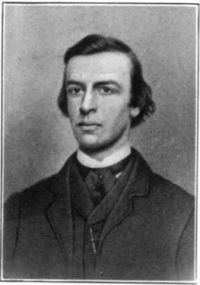
“ RIEMANN, GEORG FRIEDRICH BERNHARD (1826–1866) , German mathematician, was born on the 17th of September 1826, at Breselenz, near Dannenberg in Hanover. His father, Friedrich Bernhard Riemann, came from Mecklenburg, had served in the war of freedom, and had finally settled as pastor in Quickborn. Here with his five brothers and sisters Riemann spent his boyhood and received, chiefly from his father, the elements of his education. ”
Source: Wikisource

Portrait of James Clerk Maxwell James Clerk Maxwell,  A Treatise on Electricity and Magnetism (1873)

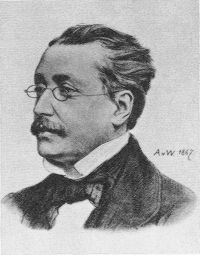
“ In a memoir presented to the Royal Society of Gottingen in 1858, but afterwards withdrawn, and only published in Poggendorff's Annalen in 1867, after the death of the author, Bernhard Riemann deduces the phenomena of the induction of electric currents from a modified form of Poisson's equation
where is the electrostatic potential, and a velocity.
This equation is of the same form as those which express the propagation of waves and other disturbances in elastic media. The author, however, seems to avoid making explicit mention of any medium through which the propagation takes place.
The mathematical investigation given by Riemann has been examined by Clausius
”
Source: Wikisource

1911 Encyclopædia Britannica (1910)

“ This double position was very difficult; in the following campaigns, ably and resolutely conducted as they were, Bernhard sometimes pursued a purely French policy, whilst at other times he used the French mercenaries to forward the cause of the princes. From a military point of view his most notable achievements were on the common ground of the upper Rhine, in the Breisgau. In his great campaign of 1638 he won the battles of Rheinfelden, Wittenweiher and Thann, and captured successively Rheinfelden, Fieiburg and Breisach, the last reputed one of the strongest fortresses in Europe. ”
Source: Wikisource

Get perspective with Kwize: daily news enlightened by great literature