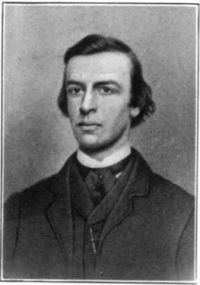
Samuel Willoughby Duffield

Samuel Willoughby Duffield

Summary

Portrait of Samuel Willoughby Duffield Samuel Willoughby Duffield The Latin Hymn-writers and Their Hymns

We praise the Holy Trinity,
And render thanks, O God, to thee!
What Ruskin remarks of the disposition of the art of the time to dwell on the darker side of things—to insist on the seeming preponderance of darkness over light, death over life—is seen also in its hymns. The Advent hymn, Veni, veni, rex gloriae, is as gloomy a lucubration as ever was associated with a Church festival. The Homo tristis esto, which is a study of the Lord’s passion apart from His resurrection, is hardly more gloomy. But other poets have more joyful strains.
Source: Gutenberg

Portrait of Samuel Willoughby Duffield Samuel Willoughby Duffield The Latin Hymn-writers and Their Hymns

Nothing is thine which thy spirit may lose again—
What this world gave it intendeth to choose again;
Lift up thy thought where the heart hath its treasure-house—
Happy art thou to despise this Earth’s pleasure-house!
We are not to imagine that these stirring verses, whether in Latin or in Italian, went unnoticed. In the various productions of his muse the humble monk enjoyed a popularity like that of Abelard. Numerous manuscripts of his writings were scattered through Italy, France, and Spain, and translations in these different languages helped to increase his fame.
Source: Gutenberg

Portrait of Samuel Willoughby Duffield Samuel Willoughby Duffield The Latin Hymn-writers and Their Hymns

THE STUDY OF THE LATIN HYMNS.
The genealogy of the song of praise in the mediaeval and modern Christian Church is both simple and beautiful. It begins far back, as we have seen, in the chants and psalms of the Hebrew. Then it changes to the Syriac and the Greek. Then it emerges into the Latin. Next it is caught up in the old High-German poetry, and at length it becomes the modern English hymn. The line of direct descent is like that of some high and puissant family whose inheritance is transferred now to one branch and now to another, but whose noble lineage is never lost.
Source: Gutenberg

Get perspective with Kwize: daily news enlightened by great literature