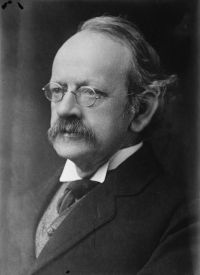
James Clerk Maxwell

Biographical details

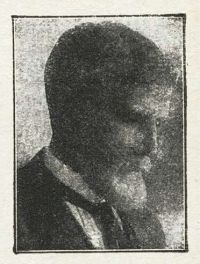
Portrait of James Clerk Maxwell James Clerk Maxwell Popular Science Monthly (1874)

A molecule of hydrogen, for example, whether in Sirius or in Arcturus, executes its vibrations in precisely the same time.
Each molecule, therefore, throughout the universe, bears impressed on it the stamp of a metric system as distinctly as does the metre of the Archives of Paris, or the double royal cubit of the Temple of Karnac.
No theory of evolution can be formed to account for the similarity of molecules, for evolution necessarily implies continuous change, and the molecule is incapable of growth or decay, of generation or destruction.
None of the processes of Nature, since the time when Nature began, have produced the slightest difference in the properties of any molecule.
Source: Wikisource

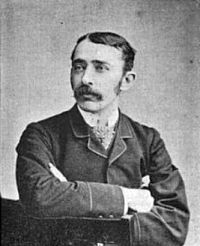
Portrait of James Clerk Maxwell James Clerk Maxwell A Treatise on Electricity and Magnetism (1873)

The experimental investigation by which Ampère established the laws of the mechanical action between electric currents is one of the most brilliant achievements in science.
The whole, theory and experiment, seems as if it had leaped, full grown and full armed, from the brain of the 'Newton of electricity. It is perfect in form, and unassailable in accuracy, and it is summed up in a formula from which all the phenomena may be deduced, and which must always remain the cardinal formula of electro-dynamics.
Source: Wikisource

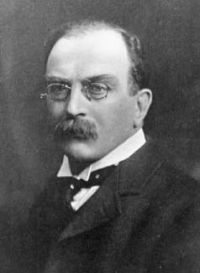
Portrait of James Clerk Maxwell James Clerk Maxwell A Dynamical Theory of the Electromagnetic Field (1865)

The most obvious mechanical phenomenon in electrical and magnetical experiments is the mutual action by which bodies in certain states set each other in motion while still at a sensible distance from each other. The first step, therefore, in reducing these phenomena into scientific form, is to ascertain the magnitude and direction of the force acting between the bodies, and when it is found that this force depends in a certain way upon the relative position of the bodies and on their electric or magnetic condition, it seems at first sight natural to explain the facts by assuming the existence of something either at rest or in motion in each body, constituting its electric or magnetic state, and capable of acting at a distance according to mathematical laws.
Source: Wikisource

Get perspective with Kwize: daily news enlightened by great literature