General relativity

Definition and stakes

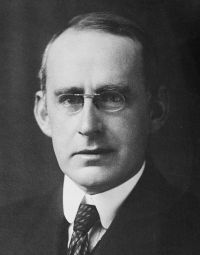
Portrait of Arthur Eddington Arthur Eddington,  Space Time and Gravitation: An outline of the general relativity theory… (1920)

“ The theory of relativity has passed in review the whole subject-matter of physics. It has unified the great laws, which by the precision of their formulation and the exactness of their application have won the proud place in human knowledge which physical science holds to-day. And yet, in regard to the nature of things, this knowledge is only an empty shell—a form of symbols. It is knowledge of structural form, and not knowledge of content. All through the physical world runs that unknown content, which must surely be the stuff of our consciousness. ”
Source: Wikisource

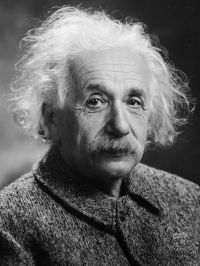
Portrait of Albert Einstein Albert Einstein,  The Principle of Relativity

“ From these discussions we see, that the working out of the general relativity theory must, at the same time, lead to a theory of gravitation; for we can “create” a gravitational field by a simple variation of the co-ordinate system. Also we see immediately that the principle of the constancy of light-velocity must be modified, for we recognise easily that the path of a ray of light with reference to K′ must be, in general, curved, when light travels with a definite and constant velocity in a straight line with reference to K.
§ 3. The time-space continuum.
”
Source: Gutenberg

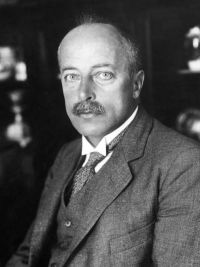
Max Planck,  Eight Lectures on Theoretical Physics… (1915)

“ The principle of relativity holds, not only for processes in physics, but also for the physicist himself, in that a fixed system of physics exists in reality only for a given physicist and for a given time. But, as in the theory of relativity, there exist invariants in the system of physics: ideas and laws which retain their meaning for all investigators and for all times, and to discover these invariants is always the real endeavor of physical research. ”
Source: Wikisource

Get perspective with Kwize: daily news enlightened by great literature