Special relativity

Definition and stakes

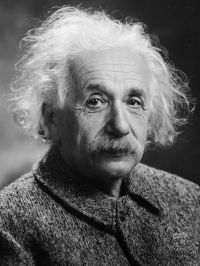
Portrait of Albert Einstein Albert Einstein,  The Principle of Relativity

“ The Special Relativity Theory does not differ from the classical mechanics through the assumption of this postulate, but only through the postulate of the constancy of light-velocity in vacuum which, when combined with the special relativity postulate, gives in a well-known way, the relativity of synchronism as well as the Lorenz-transformation, with all the relations between moving rigid bodies and clocks.
The modification which the theory of space and time has undergone through the special relativity theory, is indeed a profound one, but a weightier point remains untouched.
”
Source: Gutenberg

Portrait of Albert Einstein Albert Einstein,  Relativity : the Special and General Theory (1920)

“ No fairer destiny could be allotted to any physical theory, than that it should of itself point out the way to the introduction of a more comprehensive theory, in which it lives on as a limiting case.
In the example of the transmission of light just dealt with, we have seen that the general theory of relativity enables us to derive theoretically the influence of a gravitational field on the course of natural processes, the laws of which are already known when a gravitational field is absent.
”
Source: Gutenberg

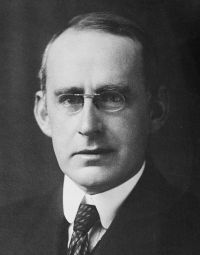
Portrait of Arthur Eddington Arthur Eddington,  The theory of relativity and its influence on scientific thought (1922)

“ If I have succeeded in my object, you will have realized that the present revolution of scientific thought follows in natural sequence on the great revolutions at earlier epochs in the history of science. Einstein's special theory of relativity, which explains the indeterminateness of the frame of space and time, crowns the work of Copernicus who first led us to give up our insistence on a geocentric outlook on nature; ”
Source: Wikisource

Get perspective with Kwize: daily news enlightened by great literature