Summary

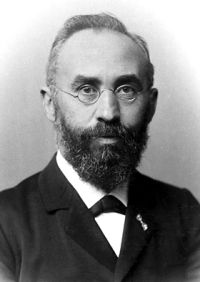
Portrait of Hendrik Lorentz Hendrik Lorentz Translation:The Principle of Relativity and its Application to some Special Physical Phenomena (1910/3)

The relativity principle asserts the following: When a physical phenomenon is described in reference system by certain equations, then a phenomenon which can be described in another reference system by the same equations, will exist as well. There, both reference systems are connected by relations in which the speed of light occurs, and which express that a system is moving with uniform velocity relative to the other one.
Source: Wikisource

Portrait of Hendrik Lorentz Hendrik Lorentz Translation:The Principle of Relativity and its Application to some Special Physical Phenomena (1910/3)

In the same way, all molecular forces acting in the interior of ponderable matter, as well as the quasi-elastic forces and resisting forces acting upon the electron, must satisfy certain conditions in order to be in agreement with the relativity principle. Then, every moving body will be invariable for a co-moving observer, yet it will experience a change of dimensions for a stationary observer, which is just a consequence of the change of molecular forces required by those conditions.
Source: Wikisource

Portrait of Hendrik Lorentz Hendrik Lorentz Translation:The Principle of Relativity and its Application to some Special Physical Phenomena (1910/3)

Eventually we want to turn our attention to gravitation. The relativity principle requires a modification of Newton's laws, above all it requires the propagation of this effect with the speed of light. The possibility of a finite propagation velocity of gravitation was already discussed by Laplace, who imagined a fluid streaming against the sun as the cause of gravity, which pushes the planets towards the sun.
Source: Wikisource

Get perspective with Kwize: daily news enlightened by great literature