Summary

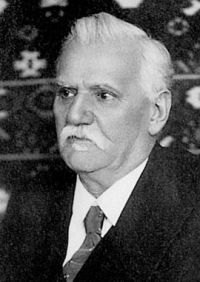
Portrait of Vladimir Varićak Vladimir Varićak Translation:On the Non-Euclidean Interpretation of the Theory of Relativity (1912)

At this place I want to remind the words of Minkowski: "It cannot be a great problem for a mathematician, who is accustomed to considerations on multi-dimensional manifolds and also on the expressions of the so called non-euclidean geometry, to adapt the notion of time to the application of the Lorentz-transformation."
Source: Wikisource

Portrait of Vladimir Varićak Vladimir Varićak Translation:On the Non-Euclidean Interpretation of the Theory of Relativity (1912)

Here, it would not be hard to introduce the reduced velocity v, as well as to calculate the deviation of the resultant in the general case, where the components enclose an arbitrary angle with each other. If we compose three to each other perpendicular velocities in space, then we arrive at six resultants of different direction.
In Lobachevskian geometry there are no similar figures. On the other hand, in relativity theory there is no kinematic similarity.
Source: Wikisource

Portrait of Vladimir Varićak Vladimir Varićak Translation:On the Non-Euclidean Interpretation of the Theory of Relativity (1912)

From N we let fall the perpendicular NP upon T, then we construct the perpendicular NR upon NP in N, then we lay off the line MS equal to the absolute unit distance of our Lobachevskian space upon T, and from S we let fall the perpendicular SR upon NR. If we additionally make NU = PS, then NU will be parallel to T in the Lobachevskian sense, and this parallel encloses with the X-axis the angle .
Since point U lies always between S and R, it can easily be seen from the figure that in relativity theory is smaller than of ordinary mechanics.
Source: Wikisource

Get perspective with Kwize: daily news enlightened by great literature