Summary

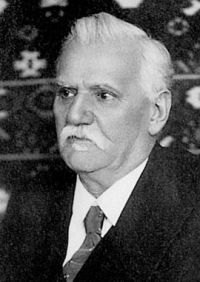
Portrait of Vladimir Varićak Vladimir Varićak Translation:Application of Lobachevskian Geometry in the Theory of Relativity (1910)

For ordinary velocities, the results calculated according to the relativity formulas, practically do not differ from these calculated according to the ordinary mechanical expressions. Also for distances of ordinary lengths, the calculations according to the Lobachevskian geometry do not differ from the euclidean calculations. In relativity theory there exists an absolute speed, in Lobachevskian geometry there exists an absolute length.
In relativity theory all bodies in motion are subjected to a certain deformation.
Source: Wikisource

Portrait of Vladimir Varićak Vladimir Varićak Translation:Application of Lobachevskian Geometry in the Theory of Relativity (1910)

The analogies that exist between relativity theory and Lobachevskian geometry are in any case interesting. The formulas of recent mechanics for are reduced to the formulas of Newtonian mechanics. Similarly also the Lobachevskian geometry, if we take the so called radius of curvature as infinite, goes over into the euclidean geometry.
Source: Wikisource

Portrait of Vladimir Varićak Vladimir Varićak Translation:Application of Lobachevskian Geometry in the Theory of Relativity (1910)

If we take , then the straight line upon which that point is moving, encloses the angle λ with the x-axis. However, if c remains finite and equal to the propagation velocity of light in empty space, then we find the direction coefficients of that straight line as:
If u is the hypotenuse and is an acute angle in the right angled Lobachevskian triangle, then is the second acute angle. It will be the smaller, the greater the translation velocity of S'. For v = c we have .
We define s as the extension of a stationary electron in the direction of the x-axis.
Source: Wikisource

Get perspective with Kwize: daily news enlightened by great literature