Summary

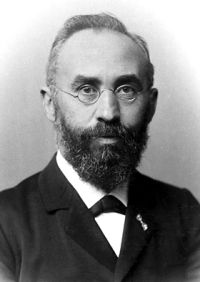
Portrait of Hendrik Lorentz Hendrik Lorentz The Michelson-Morley Experiment and the Dimensions of Moving Bodies (1921)

In our problem the body is supposed to move in a normal system of co-ordinates. By this our formula; simplify to [1]
When applied to a revolving body, these equations will enable us to determine the deformation that is produced, wholly independently of the theory of relativity, by centrifugal force, a deformation that will in reality far surpass the changes we want to consider. To get free from it we can consider the ideal case of a "rigid" body — i.e. a body for which the moduli of elasticity and in (6) are infinitely great.
Source: Wikisource

Portrait of Hendrik Lorentz Hendrik Lorentz The Michelson-Morley Experiment and the Dimensions of Moving Bodies (1921)

As to the co-ordinates , it may be recalled that, in a field free from gravitation, they may be chosen in such a manner ( being at right angles to each other) that the velocity of light has the constant magnitude ; the potentials will in this case have the values
for
These may be called the normal values of the potentials, and a system of co-ordinates for which they hold a normal system.
Let us now consider a solid body , and let us first conceive it to be placed in a normal system of co-ordinates () , and to be at rest in that system, free from all external forces.
Source: Wikisource

Portrait of Hendrik Lorentz Hendrik Lorentz The Michelson-Morley Experiment and the Dimensions of Moving Bodies (1921)

On the ground of it we shall commit no error if, in determining the paths and of two rays that start from a point , and are made to interfere at a point , we take no account of the motion of the apparatus. The change in the difference of phase produced by the translation will be given by the difference between the values which the integral
takes for the lines and so determined.
Source: Wikisource

Get perspective with Kwize: daily news enlightened by great literature