Summary

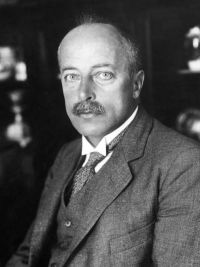
Portrait of Max von Laue Max von Laue Two Objections Against the Theory of Relativity and their Refutation

Of all apparently paradox consequences that stem from the time-transformation of the theory of relativity, there is probably none, against which the common sense of anyone (who is still unfamiliar with the matter) is more reluctant, than the one according to which the time indication of a clock shall be dependent on its state of motion.
Source: Wikisource

Portrait of Max von Laue Max von Laue Two Objections Against the Theory of Relativity and their Refutation

To conclude different validities of the possible strides from the non-existence of certain imaginable strides, is not allowed.
For the rest it seems to me, as if the whole question after the existence of the aether and absolute time could be banned out of the physical discussion; as long as no totally new facts can be demonstrated by experiment, as for example the existence of superluminal velocities or a contradiction between the phenomena of gravitation and the relativity principle, it cannot be physically distinguished between both mentioned standpoints.
Source: Wikisource

Portrait of Max von Laue Max von Laue Two Objections Against the Theory of Relativity and their Refutation

And when Wiechert writes [5] : "Yet, as soon as the validity of the relativity principle will be concluded from the observations, so that (as previously described) a natural limitation of the ordinary states of motion must be assumed, is is impossible to avoid the conclusion, that just not all strides are equivalent for the world process", then this conclusion is totally inadmissible in the system of the unconditional relativity principle. Because this view necessarily must deny the occurrence of superluminal velocities for matter.
Source: Wikisource

Get perspective with Kwize: daily news enlightened by great literature