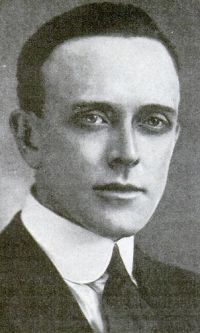
Daniel Frost Comstock

Daniel Frost Comstock

Summary

Portrait of Daniel Frost Comstock Daniel Frost Comstock The Principle of Relativity (1910)

Are we to consider ourselves with the clock system when we answer, or passing the clocks with a hundredth the velocity of light or passing the clocks with a tenth the velocity of light? The answer in each case must be different, but in each case may be true.
It must be remembered that the results of the principle of relativity are as true and no truer than its postulates.
Source: Wikisource

Portrait of Daniel Frost Comstock Daniel Frost Comstock The Principle of Relativity (1910)

We are, therefore, forced to the conclusion that, unless we discard one of the two relativity postulates, the simultaneity of two distant events means a different thing to two different observers if they are moving with respect to each other.
The fact that the moving observer disagrees with us as to the reading of his two clocks as well as to the reading of two similar clocks on our "stationary" platform, gives us a complete basis for all other differences due to point of view.
Source: Wikisource

Portrait of Daniel Frost Comstock Daniel Frost Comstock The Principle of Relativity (1910)

Two clocks, one at A and the other at B, can therefore be set running in unison by means of a light signal sent to each from a place midway between them.
Now suppose both clock A and clock B are on a kind of sidewalk or platform moving uniformly past us with velocity v. In Fig. 1 (2) is the moving platform and (1) is the fixed one, on which we consider ourselves placed. Since the observer on platform (2) is moving uniformly he can have no reason to consider himself moving at all, and he will use just the method we have indicated to set his two clocks A and B in unison.
Source: Wikisource

Get perspective with Kwize: daily news enlightened by great literature