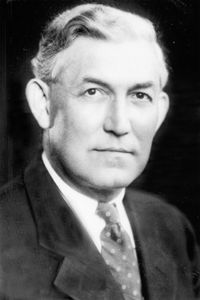
Robert Daniel Carmichael

Robert Daniel Carmichael

Summary

Portrait of Robert Daniel Carmichael Robert Daniel Carmichael On the Theory of Relativity: Mass… (1913)

From some results in the preceding discussion it has appeared that the transverse mass of a body is merely a manifestation of its total energy, that it is in fact a measure of that energy. It is then natural to suppose, on the other hand, that anything which possesses energy has mass; and we thus conceive of mass and energy as coextensive.
Now a beam of light possesses energy; whence we conclude naturally that it also has mass. But we have seen that no "material body" can have a velocity as great as that of light.
Source: Wikisource

Portrait of Robert Daniel Carmichael Robert Daniel Carmichael On the Theory of Relativity: Mass… (1913)

Undoubtedly the principle of least action is one which should be given up only when there are strong reasons for it. It is a mathematical formulation of the law that nature accomplishes her ends with the least possible expenditure of labor, so to speak. Certainly this law is one which appeals to our minds with strong force. There is something about it which is aesthetically satisfying in a high degree. It seems to me, however, that a fresh study of it should be made in the light of the theory of relativity.
Source: Wikisource

Portrait of Robert Daniel Carmichael Robert Daniel Carmichael On the Theory of Relativity: Mass… (1913)

Many persons have found no difficulty in accepting postulate M; certain it is at least that we have absolutely no evidence to contradict it. We have seen in theorem V, that these four postulates, taken in connection with the formula for transverse mass, form an essential equivalent of ; in other words, the experimental demonstration of the formula for transverse mass carries with it the experimental proof of the theory of relativity, provided that postulates are accepted as experimentally proved.
Source: Wikisource

Get perspective with Kwize: daily news enlightened by great literature