“ IanThe clocks! Bring them! [Seizes the spade over by the house; begins to dig a grave behind the sun-dial.] Bring every one! We will bury the clocks before the sun-dial—an offering, a living sacrifice. I tell you this is great, Eloise. What is a clock? Something agreed upon and arbitrarily imposed upon us. Standard time. Not true time. Symbolizing the whole standardization of our lives. Clocks! Why, it is clockiness that makes America mechanical and mean! Clock-minded! A clock is a little machine that shuts us out from the wonder of time. ”
Clock
Definition and stakes
A clock is a device that measures and displays time, with its origins traceable to ancient tools such as sundials and water clocks, which later developed into mechanical and electronic versions. From Susan Glaspell’s critique of clocks as symbols of standardized, mechanized life to Arthur Hayden’s reflection on their role as decorative remnants, authors have examined their dual function as practical tools and metaphors for human temporality.
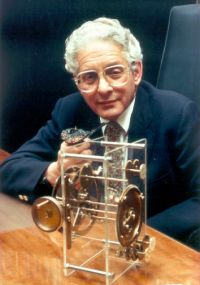
Derek J. de Solla Price’s historical studies and Jerome K. Jerome’s witty observations highlight their cultural significance, while Robert Southey’s poetic homage underscores their emotional impact. Clocks, therefore, represent both the accuracy of timekeeping and the existential questions it provokes.
Quotes about “clock”
G. Hastie, Folk-Lore (1893)
“ The eyes of the immense crowd are ever being turned towards the lighted clock-face of the "Auld and Faithfu" Tron, the hour approaches, the hands seem to stand still, but in one second more the hurrahing, the cheering, the hand-shaking, the health-drinking, the swaying to and fro of the immense throng, is all kept up as long as the clock continues to ring out the much-longed-for midnight hour. ”
George F. Worts, Peter the Brazen: A Mystery Story of Modern China
“ The face of the clock. The hands, like black daggers, had pointed to ten minutes of one. Ten minutes of life! Ten minutes to live! Or—less? Silence, broken only by the reluctant click-clack, click-clack of the rosewood clock. ”
Morris Rosenfeld,
Songs of Labor, and Other Poems
“ I drive the wheel madly as tho’ to o’ertake them,— Give chase without wisdom, or wit, or avail.The clock in the workshop,—it rests not a moment; It points on, and ticks on: Eternity—Time; And once someone told me the clock had a meaning,— Its pointing and ticking had reason and rhyme. And this too he told me,—or had I been dreaming,— The clock wakened life in one, forces unseen, And something besides;... I forget what; Oh, ask not! I know not, I know not, I am a machine.At times, when I listen, I hear the clock plainly;— The reason of old—the old meaning—is gone! ”
Arthur Hayden, Chats on Old Clocks
“ A clock is an ornament to a well appointed home, in the hall, in the smoking-room, or in the dining-room. [Pg 42] They are unconcerned as to whether it is a timekeeper or a monument, "long to be patient and silent to wait like a ghost that is speechless." One longs to call aloud to such an encumbrance with its dead wheels and its atrophied hands: "Watchman! What of the night?" It is a servant that serves no longer. ”
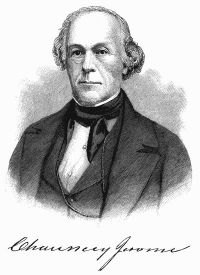
Jerome K. Jerome,
Clocks
(1909)
“ There are two kinds of clocks. There is the clock that is always wrong, and that knows it is wrong, and glories in it; and there is the clock that is always right—except when you rely upon it, and then it is more wrong than you would think a clock could be in a civilized country. ”
Robert Southey,
The doctor, &c., vol. 1 (of 7)
(1834)
“ This was the clock which, with few intervals, measured out by hours the life of Daniel Dove from the seventeenth year of his age, when he first set up his rest within its sound.Perhaps of all the works of man sun-dials and church-clocks are those which have conveyed most feeling to the human heart; the clock more than the sun-dial because it speaks to the ear as well as to the eye, and by night as well as by day. Our forefathers understood this, and therefore they not only gave a Tongue to Time, but provided that he should speak often to us and remind us that the hours are passing. ”
Elsie De Wolfe,
The House in Good Taste
“ I am such a crank about good clocks that I take my own with me, even on a railway train. I think I have the smallest clock in the world which strikes the hours. There are many tiny clocks made which strike if one touches a spring, but my clock always strikes of itself. ”
John Ayrton Paris,
Philosophy in Sport Made Science in Earnest
“ A clock is nothing more than a piece of machinery to maintain the action of the pendulum, and at the same time to count and register the number of its oscillations; and by that peculiar property, that one vibration commences exactly where the last terminates, no part of time is lost or gained in the juxtaposition of the units so counted. ”
Algernon Blackwood,
The Extra Day — Chapter XIV: Maria Stirs
(1915)
“ A clock is just a mechanical invention that ticks off the movements of the sun into seconds and minutes and hours. Both clocks and calendars, therefore, are mere measuring tricks. Time goes on, or does not go on, just the same, whether you possess these inventions or whether you do not possess them. Both clocks and calendars go at the same rate whether Time goes fast or slow. ”
Sara Ware Bassett, Christopher and the Clockmakers
“ It is an interesting subject and one that never seems to exhaust itself. For all the wonders of my trade are not yet told. When, for instance, they put the clock on the Metropolitan Life Insurance building here in New York an undreamed-of pinnacle in clock construction was reached. There was a time when the clock on the London Houses of Parliament was the last word in the art—a veritable triumph of the horologe. Not only was it the largest timepiece in the world, but it seemed then the most miraculous. ”
E. Nesbit,
The House of Arden: A Story for Children
“ The Mouldiwarp giggled. “My child, what presumption! The clock is much too big for you to see ever—all at once. The sun’s the centre of it. This is just a pretending clock. It’ll do for what we want, of course, or I wouldn’t have had it made for you. Sit down on the second hand—oh no, it won’t hurt the daisies. ”
William Holmes McGuffey,
McGuffey's Third Eclectic Reader
“ LESSON XXVIII.THE CLOCK AND THE SUNDIAL. A FABLE. 1. One gloomy day, the clock on a church steeple, looking down on a sundial, said, THIRD READER. 73 "How stupid it is in you to stand there all the while like a stock! 2. "You never tell the hour till a bright sun looks forth from the sky, and gives you leave. I go merrily round, day and night, in summer and winter the same, without asking his leave. 3. "I tell the people the time to rise, to go to dinner, and to come to church. ”
active 1857-1887 James W. Benson, Time and Time-Tellers
“ In ancient books the word cloche simply stands for a bell,—the monks being accustomed to ring a bell at certain periods marked for them by their sun-dials or hour-glasses, and 'What's o'clock?' in old writers is often merely equivalent to the inquiry, 'What hour was last struck by bell?' The word horologe or hour-measurer of course equally applied to the sun-dial, the clepsydra, and the clock, and this convertibility of terms makes it all the more difficult to trace the point at which the newer invention began. ”
Gaston Leroux,
The Man with the Black Feather
(1912)
“ When he recovers his senses, the hand of the clock has moved on ten minutes. Torn by fears and suspense, he listens with all his ears. He hears faint movements on the floor above. The minutes pass; twenty minutes pass. ”
Harry Jones, Once a Week (1862)
“ The clock strikes with a steady pulse, though sometimes it seems in a fever—sometimes in a fit. At any rate we have some fixed standard to correct the calculation of our waking time; but in dreams the standard itself is visionary. ”
A. H. Vesey, The Clock and the Key
“ When the clock had been in perfect repair the ten disks must have been the basis for ten automata, much after the fashion of the Noah’s Ark men of our childhood. Naturally, the ten figures suggested the Council of Ten, and the single figure the Doge. But one would need some imagination to guess their significance. The clock might have a wonderful secret to tell, but it would take a genius or extraordinary luck to puzzle it out. ”
Robert W. Chambers,
The Mystery of Choice
“ The little American clock on the mantel ticked and ticked, but the hands lagged, for he had not been occupied five minutes in all. He went up to the mantel and watched the hands of the clock. A minute—longer than a year to him—crept by. ”
James Arthur, Time and Its Measurement
“ This I consider a perfect striking clock. It is a large movement of fine workmanship and was made in the department of the Jura, France. When a clock or watch only repeats, I consider the old “five-minute repeater” the best. I used this method in a clock which, on pulling the cord, strikes the hour on a large bell and if that is all it strikes, then it is less than five minutes past. If more than five minutes past it follows the hour by one blow on a small bell for every five minutes. ”
Laura Lee Hope, The Outdoor Girls at Rainbow Lake (1913)
“ Just then a clock chimed out eight strokes, in four sections of two strokes each. "Eight o'clock!" exclaimed Amy. "Your timepiece must be wrong, Betty. It's nearer noon than eight." "That's eight bells—twelve o'clock," said the pretty hostess, with a laugh. "That's a new marine clock Uncle Amos gave me for the Gem. It keeps time just as it is done on shipboard." "And when it's eight o'clock it's twelve," murmured Grace. "Do you have to do subtraction and addition every time the clock strikes?" ”
Edmund Beckett, Henry Hardinge Cunynghame, and James George Joseph Penderel-Brodhurst, 1911 Encyclopædia Britannica, Volume 6… (1911)
“ The watchman’s or tell-tale clock, used when it is desired to make sure of a watchman being on the spot and awake all the night, is a clock with a set of spikes, generally 48 or 96, sticking out all round the dial, and a handle somewhere in the case, by pulling which one of the spikes which is opposite to it, or to some lever connected with it is pressed in. This wheel of spikes is carried round with the hour-hand, which in these clocks is generally a twenty-four hour one. ”
Stephen Graham,
Through Russian Central Asia
(1916)
“ The hour is not a matter of anxiety; dawn, noon, sunset, night are the quarters of the clock, and they suffice. But in the post-station at Kopal, whilst the Chinese were officiously effacing themselves, I found myself idly looking at the big clock hanging in a shadowy corner and trying to make out the hour. The face of the clock was a tiger looking at a snake. When it was twelve o’clock the hands were between the tiger’s eyes. At a quarter-past seven the hands held the serpent. ”
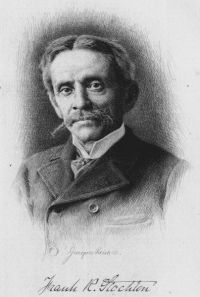
Frank R. Stockton,
Fanciful tales
(1922)
“ THE CLOCKS OF RONDAINEThis story naturally leads to the history of clocks and time-pieces of various kinds, from the crude hour-glass, the burning candle graduated to last a certain time, the water-clock, much the same as the hour-glass, and the dial on which the shadow of the sun is traced, down to the clocks which we [134] have now, and especially those of finest mechanism and beautiful ornamentation.The industry of clock-making is a very important one. In the United States it has been built up almost entirely in the last sixty years. ”
Arthur Hayden, Chats on Old Clocks
“ Time and its measurement—Day and night—Early mechanism—The domestic clock—The personal clock—Rapid phases of invention—The dawn of science—The great English masters of clockmaking—The several branches of a great art—What to value and what to collect—Hints for beginners.The dictionary definition of "clock" is interesting. Clock.—A machine for measuring time, marking the time by the position of its hands upon the dial-plate, or by the striking of a hammer on a bell. Probably from old French or from Low Latin, cloca, clocca, a bell. Dutch, klok. ”
Arthur Hayden, Chats on Old Clocks
“ The Several Branches of a Great Art.—The timekeeper—whether it be the scientific astronomical clock, or the chronometer used by mariners, or the modern watch, minute in size but recording time with accuracy, or the bracket or table clock, or the long-case clock—has proceeded on parallel lines of development. ”
active 1857-1887 James W. Benson, Time and Time-Tellers
“ A Church tower without a clock and bells seems an unfurnished edifice, which must be fitted and filled before it can serve the purpose for which it was built;—like a form without life, a body without a soul. A good Church clock is useful to everybody; it is the friendly monitor alike of rich and poor,—the regulator of every private time-piece,—the standard of time for a whole parish or township. By it the artisan or mechanic trudges off to his daily labour ”
Various, Little Folks (September 1884)
“ A very pretty and uncommon object to copy is that of an old-fashioned clock, a veritable "my grandfather's clock," an upright tall eight-day clock that has a long chain and a heavy pendulum concealed within its tall case, and that shows a big square face with large figures printed on it. I will give you a few details about my cork clock, and I think you will make one and set it upon a bracket to be admired by all beholders. This miniature clock stands 71⁄2 inches high. ”
Bruce S. Wright, The Children's Six Minutes
“ But there is a clock surpassing all others. I call it God's clock. It is the Sun. Since time began God's clock has kept time. It is the central clock of our universe. It regulates all others. It does not have to be wound. God has seen to that. How can we help worshiping the God who has made such a clock!MEMORY VERSE, Psalm 74: 16"The day is thine, the night also is thine; thou hast prepared the light and the sun."MEMORY HYMN [47] "Sun of my soul, thou Saviour dear." ”
Arthur Hayden, Chats on Old Clocks
“ One lingers over their ornament with loving regard and forgets their purport. As timekeepers they fell short of the abbey clock, or of the sundial—a perennial stickler for truth when the sun shone. When the long pendulum, under the auspices of Christopher Huygens, commenced swinging, a timekeeper ready to hand eclipsed their gold and enamelled triumphs. But as fashionable baubles they had their continuous evolution, from Thomas Chamberlaine de Chelmisforde to Pinchbeck, and from Tompion to Eardley Norton. ”
James Arthur, Time and Its Measurement
“ So we have a complete striking clock made by a man so poor that he had only his anvil, hammer and file. The weights are hung on cords as thick as an ordinary lead pencil and pass over pulleys having spikes set around them to prevent the cords from slipping. The weights descend 7 ft. in 12 hours, so they must be pulled up—not wound up—twice a day. The single hour hand is a work of art and is cut through like lace. Public clocks may still be seen in Europe with only one hand. ”
Ernest Gallaudet Draper, Lectures in Navigation
“ You cannot manufacture a clock which will run that way because the hours of a clock must be all of exactly the same length and it must make noon at precisely 12 o'clock every day. Hence we distinguish clock time from sun time by calling clock time, mean (or average) time and sun time, apparent or solar time. From this explanation you are ready to understand such expressions as Local Mean Time, which, in untechnical language, signifies clock time at the place where you are; Greenwich Mean Time which signifies clock time at Greenwich ”
Sara Ware Bassett, Christopher and the Clockmakers
“ Still higher up are figures to symbolize childhood, youth, manhood, and old age, each of which strikes one of the quarter hours. Beside the ordinary clock dial you will see a moving figure that strikes with its scepter the first note of each quarter hour, while at the same time a figure opposite it turns an [78] hourglass to mark the complete passing of the hour.""Gee!""Oh, don't imagine you are through with this marvelous clock yet. There is in addition a grim statuette of death which is to remind man of his frailty and the shortness of his days; this strikes each hour with a bone. ”
Ben Hecht,
A Thousand and One Afternoons in Chicago
“ The clock in a candy store window says "Three-twelve." A few windows down, another clock says "Three-five." The newspaper man walks to his home studying the clocks. They all disagree as before. And yet their faces are all identical—as identical as the faces of the owl car passengers seem to the conductor. And here is a clock that has stopped. It says "Twenty after four." And the newspaper man thinks of the picture the conductor identified in the papers the next morning. ”
James Arthur, Time and Its Measurement
“ On this dial, Fig. 19, nine is noon, as usual, and is on top side of dial. Hand points to three quarters past seven, that is, a quarter to six, near sunset. Between the bell and the top of the clock body two horizontal balances, having small weights hung on them, are plainly shown, and the clock has two verge escapements—one connected with each balance, or “foliot.” Let us suppose a long day coming to a close at sunset, just as the hand indicates. The upper balance, which is the slow one, has been swinging backwards and forwards measuring the long hours of the day. ”
James Arthur, Time and Its Measurement
“ The clock hand is the heavy arrow and sweeps the dial once in a whole day, same direction as our clocks. This circle of the months moves along with the hand, but a little faster, so as to gain one number in a month. As shown on the figure it is about one week into the sixth month. Next outward is the broad band having twelve curved lines for the hours ending outwardly in a ring divided into 100 parts, marked off in tens by dots. These curved lines are numbered with the Japanese numerals for hours which you must now be able to read easily. ”