Summary

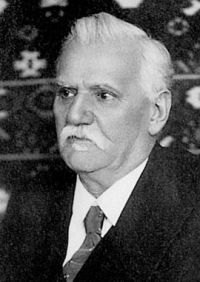
Portrait of Vladimir Varićak Vladimir Varićak Translation:The Theory of Relativity and Lobachevskian Geometry (1910)

The Lorentz-Fitzgerald hypothesis of electron contraction led me to the assumption, whether this contraction could be interpreted as a consequence of geometrical anisotropy of space. It seemed to me that this contraction is analogues to the deformation of lengths in a very familiar interpretation of Lobachevskian geometry. [3] Now it seems that my assumption of the connection of non-euclidean geometry with relativity theory can be realized.
Source: Wikisource

Portrait of Vladimir Varićak Vladimir Varićak Translation:The Theory of Relativity and Lobachevskian Geometry (1910)

From N we let fall the perpendicular NP upon MT, then we construct the perpendicular NR upon NP in N, then we lay off the line MS = 1 upon MT, and from S we let fall the perpendicular SR upon NR. If we additionally make NU = PS, then NU will be parallel to MT in the Lobachevskian sense, and this parallel encloses with the X-axis the angle . As point U always lies between S and R, it can be easily seen from the figure that in relativity theory is smaller than of ordinary mechanics.
Source: Wikisource

Portrait of Vladimir Varićak Vladimir Varićak Translation:The Theory of Relativity and Lobachevskian Geometry (1910)

Formula (1) leads to the same result at the limits of our ordinary experience. Only at velocities nearly comparable to the velocity of light, a notable difference occurs that quickly leads to infinite distortion. As unit distance we use the path of light in one second. Then
If we take v = 1 km/sec at first, then
If we neglect everything after the first term on the right-hand side, then we commit an error that not even exerts an influence upon the 10th decimal. So by our definition, we have for a velocity of 1 km/sec a length of 1 km as the representative.
Source: Wikisource

Get perspective with Kwize: daily news enlightened by great literature