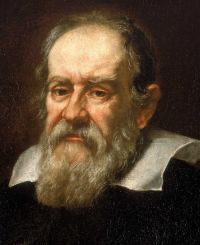
 Galileo Galilei,
Dialogues Concerning Two New Sciences…
(1638)
Galileo Galilei,
Dialogues Concerning Two New Sciences…
(1638)
“ The manner in which you compound these different momenta to obtain their resultant strikes me as so novel that my mind is left in no small confusion. I do not refer to the composition of two uniform motions, even when unequal, and when one takes place along a horizontal, the other along a vertical direction; because in this case I am thoroughly convinced that the resultant is a motion whose square is equal to the sum of the squares of the two components. The confusion arises when one undertakes to compound a uniform horizontal motion with a vertical one which is naturally accelerated. ”