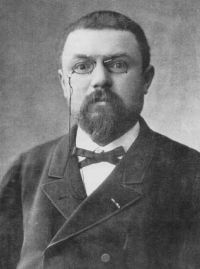
Henri Poincaré

Henri Poincaré

Summary

Portrait of Henri Poincaré Henri Poincaré Science and Hypothesis (1905)

Thus, by generalisation, every fact observed enables us to predict a large number of others; only, we ought not to forget that the first alone is certain, and that all the others are merely probable. However solidly founded a prediction may appear to us, we are never absolutely sure that experiment will not prove it to be baseless if we set to work to verify it. But the probability of its accuracy is often so great that practically we may be content with it. It is far better to predict without certainty, than never to have predicted at all.
Source: Wikisource

Portrait of Henri Poincaré Henri Poincaré Science and Hypothesis (1905)

If the sky were for ever covered with clouds, and if we had no means of observing the stars, we might, nevertheless, conclude that the earth turns round. We should be warned of this fact by the flattening at the poles, or by the experiment of Foucault's pendulum. And yet, would there in this case be any meaning in saying that the earth turns round? If there is no absolute space, can a thing turn without turning with respect to something; and, on the other hand, how can we admit Newton's conclusion and believe in absolute space?
Source: Wikisource

Portrait of Henri Poincaré Henri Poincaré Science and Hypothesis (1905)

We must therefore first define what is meant by the equality of two forces. When are two forces equal? We are told that it is when they give the same acceleration to the same mass, or when acting in opposite directions they are in equilibrium. This definition is a sham. A force applied to a body cannot be uncoupled and applied to another body as an engine is uncoupled from one train and coupled to another. It is therefore impossible to say what acceleration such a force, applied to such a body, would give to another body if it were applied to it.
Source: Wikisource

Get perspective with Kwize: daily news enlightened by great literature