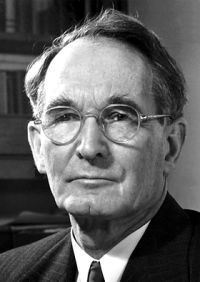
P. W. Bridgman

P. W. Bridgman

Summary

Portrait of P. W. Bridgman P. W. Bridgman The logic of modern physics (1927)

It is an impossible attitude to expect that one can maintain. Does this then mean that physics is to face a drab future, becoming continually more prosaic, with new discoveries ever rarer, made by a continually decreasing number of misguided but fortunate enthusiasts? There may be such a danger, but the greatest part of the danger is avoided if its nature is clearly recognized. One of the problems of the future is the self-conscious development of a more powerful technique for the discovery of new relations without the necessity for preconceived opinions on the part of the observer.
Source: Gutenberg

Portrait of P. W. Bridgman P. W. Bridgman The logic of modern physics (1927)

Do we believe that if we drive in our stakes at a certain point on our present frontiers, this point will gradually, as physics advances, become possessed of a continually richer experience, so that nature at this point will appear increasingly complicated? Or do we expect a termination of this process of expansion fairly soon? It seems to me that as a matter of experimental fact there is no doubt that the universe at any definite level is on the average becoming increasingly complicated, and that the region of apparent simplicity continually recedes.
Source: Gutenberg

Portrait of P. W. Bridgman P. W. Bridgman The logic of modern physics (1927)

Does not the apparent demand of our thinking apparatus to be furnished with discrete and identifiable things to think about impose a very essential restriction on any picture of the physical universe which we are able to form? We are continually surprising ourselves in the invention of discrete structure further and further down in the scale of things, whole sole raison d'être is to be found entirely within ourselves.
Source: Gutenberg

Get perspective with Kwize: daily news enlightened by great literature