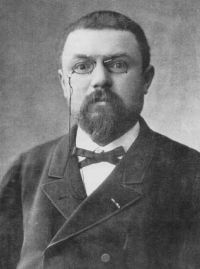
Henri Poincaré

Biographical details

Portrait of Henri Poincaré Henri Poincaré The Foundations of Science: Science and Hypothesis…

Has science any place for such theories? Why be a 'neo-vitalist,' or an 'evolutionist,' or an 'atomist,' or an 'Energetiker'? Why not say, plainly: "Such and such phenomena, thus and thus described, have been observed; such and such experiences are to be expected, since the hypotheses by the terms of which we are required to expect them have been verified too often to let us regard the agreement with experience as due merely to chance; so much then with reasonable assurance we know; all else is silence—or else is some matter to be tested by another experiment?"
Source: Gutenberg

Portrait of Henri Poincaré Henri Poincaré The Foundations of Science: Science and Hypothesis…

But if for us some day a window is opened upon world B, how we shall pity them: "Poor things," we shall say, "they think they have made a geometry, but what they call so is only a grotesque image of ours; their straights are all twisted, their circles are humped, their spheres have capricious inequalities." And we shall never suspect they say the same of us, and one never will know who is right.
We see in how broad a sense should be understood the relativity of space; space is in reality amorphous and the things which are therein alone give it a form.
Source: Gutenberg

Portrait of Henri Poincaré Henri Poincaré Science and Hypothesis (1905)

If it be said that the velocity of a body cannot change, if there is no reason for it to change, may we not just as legitimately maintain that the position of a body cannot change, or that the curvature of its path cannot change, without the agency of an external cause? Is, then, the principle of inertia, which is not an à priori truth, an experimental fact? Have there ever been experiments on bodies acted on by no forces?
Source: Wikisource

Get perspective with Kwize: daily news enlightened by great literature