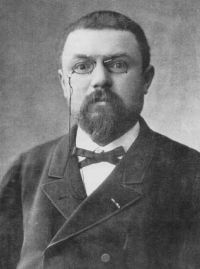
Henri Poincaré

Henri Poincaré

Summary

Portrait of Henri Poincaré Henri Poincaré The Foundations of Science (1913)

I do not hesitate to consider the physical phenomenon as anterior to the auditory image perceived in my consciousness, because I believe it is its cause.
Behold then the rule we follow, and the only one we can follow: when a phenomenon appears to us as the cause of another, we regard it as anterior. It is therefore by cause that we define time; but most often, when two facts appear to us bound by a constant relation, how do we recognize which is the cause and which the effect?
Source: Wikisource

Portrait of Henri Poincaré Henri Poincaré The Foundations of Science (1913)

We should first ask ourselves how one could have had the idea of putting into the same frame so many worlds impenetrable to one another. We should like to represent to ourselves the external universe, and only by so doing could we feel that we understood it. We know we never can attain this representation: our weakness is too great. But at least we desire the ability to conceive an infinite intelligence for which this representation could be possible, a sort of great consciousness which should see all, and which should classify all in its time, as we classify, in our time, the little we see.
Source: Wikisource

Portrait of Henri Poincaré Henri Poincaré The Foundations of Science (1913)

Let us see what the principle of the equality of action and reaction becomes in the theory of Lorentz. Consider an electron A which for any cause begins to move; it produces a perturbation in the ether; at the end of a certain time, this perturbation reaches another electron B, which will be disturbed from its position of equilibrium. In these conditions there can not be equality between action and reaction, at least if we do not consider the ether, but only the electrons, which alone are observable, since our matter is made of electrons.
Source: Wikisource

Get perspective with Kwize: daily news enlightened by great literature