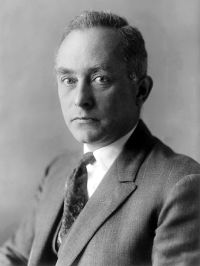
Max Born

Biographical details

Portrait of Max Born Max Born,  The Theory of the Rigid Electron in the Kinematics of the Principle of Relativity

“ Later, this concept of the rigid body proves to be fruitful for the development of dynamics itself; because the rigid body as a continuous mass system of only six degrees of freedom, is not only kinematically of the highest simplicity, but also dynamically by allowing the composition of the forces – which are acting at its points – to "resulting" forces and moments of the same magnitude, whose knowledge is sufficient for the description of motion. ”
Source: Wikisource

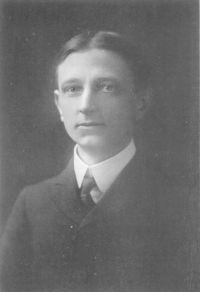
Portrait of Max Born Max Born,  The Theory of the Rigid Electron in the Kinematics of the Principle of Relativity

“ The theory of Abraham, which studies the motion of an electron (being rigid in the ordinary sense) in the force field produced by itself, has not only led to a qualitatively satisfying explanation of the phenomena of inertia of free electrons on a pure electric basis, but has also led to a quantitative law for the dependency of the electrodynamic mass from velocity at very small accelerations, which is probably not to be seen as disproved by the experiments. ”
Source: Wikisource

Portrait of Max Born Max Born,  On the Kinematics of the Rigid Body in the System of the Principle of Relativity

“ There is an instantaneous axis of rotation, i.e. by a suitable Lorentz transformation one can achieve that all points of a straight line are at rest.
6) All points of the body have a constant "rest distance" with respect to a certain point located upon the instantaneous axis, the center of rotation.
Except the identification of these general properties of the definition, I have computed some special motions, among them the case that a point of the body carries out a uniformly-accelerated motion (hyperbolic motion) , and that the body is arbitrarily rotating about the direction of translation.
”
Source: Wikisource

Get perspective with Kwize: daily news enlightened by great literature