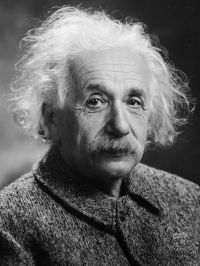
Albert Einstein

Biographical details

Portrait of Albert Einstein Albert Einstein,  Relativity: The Special and General Theory… (1920)

“ An observer who is sitting eccentrically on the disc is sensible of a force which acts outwards in a radial direction, and which would be interpreted as an effect of inertia (centrifugal force) by an observer who was at rest with respect to the original reference-body . But the observer on the disc may regard his disc as a reference-body which is "at rest"; on the basis of the general principle of relativity he is justified in doing this. The force acting on himself, and in fact on all other bodies which are at rest relative to the disc, he regards as the effect of a gravitational field. ”

Source: Wikisource

Portrait of Albert Einstein Albert Einstein,  Ether and the Theory of Relativity (1922)

“ From the present state of theory it looks as if the electromagnetic field, as opposed to the gravitational field, rests upon an entirely new formal motif, as though nature might just as well have endowed the gravitational ether with fields of quite another type, for example, with fields of a scalar potential, instead of fields of the electromagnetic type.
Since according to our present conceptions the elementary particles of matter are also, in their essence, nothing else than condensations of the electromagnetic field, our present view of the universe presents two realities which are completely separated from each other conceptually, although connected causally, namely, gravitational ether and electromagnetic field, or — as they might also be called — space and matter.
”
Source: Wikisource

Portrait of Albert Einstein Albert Einstein,  Relativity: The Special & the General Theory

“ A four-dimensional continuum described by the "co-ordinates" , , , , was called "world" by Minkowski, who also termed a point-event a "world-point." From a "happening" in three-dimensional space, physics becomes, as it were, an "existence" in the four-dimensional "world."
This four-dimensional "world" bears a close similarity to the three-dimensional "space" of (Euclidean) analytical geometry. If we introduce into the latter a new Cartesian co-ordinate system (', ', ')
”
Source: Gutenberg

Get perspective with Kwize: daily news enlightened by great literature