Albert Einstein

Albert Einstein

Summary

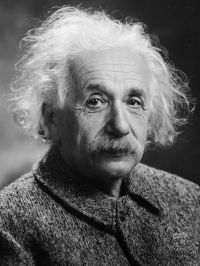
Portrait of Albert Einstein Albert Einstein Time, Space, and Gravitation (1919)

Consider the case of a system of coordinates which is conceived as being in stable rotation relative to a system of inertia in the Newtonian sense. The forces which, relatively to this system, are centrifugal must, in the Newtonian sense, be attributed to inertia. But these centrifugal forces are, like gravitation, proportional to the mass of the bodies. It is not, then, possible to regard the system of coordinates as at rest, and the centrifugal forces of gravitational? The interpretation seemed obvious, but classical mechanics forbade it.
Source: Wikisource

Portrait of Albert Einstein Albert Einstein Time, Space, and Gravitation (1919)

There are several kinds of theory in physics. Most of them are constructive. These attempt to build a picture of complex phenomena out of some relatively simple proposition. The kinetic theory of gases, for instance, attempts to refer to molecular movement the mechanical thermal, and diffusional properties of gases. When we say that we understand a group of natural phenomena, we mean that we have found a constructive theory which embraces them.
Source: Wikisource

Portrait of Albert Einstein Albert Einstein Time, Space, and Gravitation (1919)

Thermodynamics, for instance, starting from the fact that perpetual motion never occurs in ordinary experience, attempts to deduce from this, by analytic processes, a theory which will apply in every case. The merit of constructive theories is their comprehensiveness, adaptability, and clarity, that of the theories of principle, their logical perfection, and the security of their foundation.
Source: Wikisource

Get perspective with Kwize: daily news enlightened by great literature