Summary

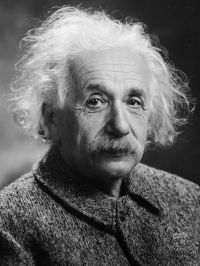
Portrait of Albert Einstein Albert Einstein The Meaning of Relativity

For even if it should appear that the universe of ideas cannot be deduced from experience by logical means, but is, in a sense, a creation of the human mind, without which no science is possible, nevertheless this universe of ideas is just as little independent of the nature of our experiences as clothes are of the form of the human body. This is particularly true of our concepts of time and space, which physicists have been obliged by the facts to bring down from the Olympus of the a priori in order to adjust them and put them in a serviceable condition.
Source: Gutenberg

Portrait of Albert Einstein Albert Einstein The Meaning of Relativity (1922)

It appears, therefore, as if there were Cartesian systems of co-ordinates, the so-called inertial systems, with reference to which the laws of mechanics (more generally the laws of physics) are expressed in the simplest form. We may infer the validity of the following theorem: If is an inertial system, then every other system which moves uniformly and without rotation relatively to , is also an inertial system; the laws of nature are in concordance for all inertial systems. This statement we shall call the "principle of special relativity."
Source: Wikisource

Portrait of Albert Einstein Albert Einstein The Meaning of Relativity

The weakness of the principle of inertia lies in this, that it involves an argument in a circle: a mass moves without acceleration if it is sufficiently far from other bodies; we know that it is sufficiently far from other bodies only by the fact that it moves without acceleration. Are there, in general, any inertial systems for very extended portions of the space-time continuum, or, indeed, for the whole universe?
Source: Gutenberg

Get perspective with Kwize: daily news enlightened by great literature