Summary

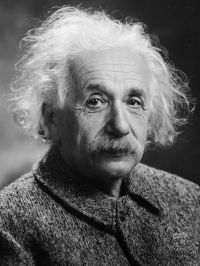
Portrait of Albert Einstein Albert Einstein Relativity: The Special and General Theory… (1920)

An observer who is sitting eccentrically on the disc is sensible of a force which acts outwards in a radial direction, and which would be interpreted as an effect of inertia (centrifugal force) by an observer who was at rest with respect to the original reference-body . But the observer on the disc may regard his disc as a reference-body which is "at rest"; on the basis of the general principle of relativity he is justified in doing this. The force acting on himself, and in fact on all other bodies which are at rest relative to the disc, he regards as the effect of a gravitational field.
Source: Wikisource

Portrait of Albert Einstein Albert Einstein Relativity: The Special and General Theory… (1920)

If we confine the application of the theory to the case where the gravitational fields can be regarded as being weak, and in which all masses move with respect to the co-ordinate system with velocities which are small compared with the velocity of light, we then obtain as a first approximation the Newtonian theory. Thus the latter theory is obtained here without any particular assumption, whereas Newton had to introduce the hypothesis that the force of attraction between mutually attracting material points is inversely proportional to the square of the distance between them.
Source: Wikisource

Get perspective with Kwize: daily news enlightened by great literature