Albert Einstein

Albert Einstein

Summary

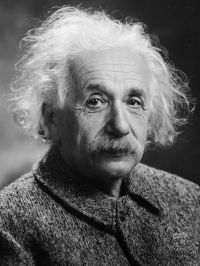
Portrait of Albert Einstein Albert Einstein Geometry and Experience (1922)

But there is another reason for the high repute of mathematics, in that it is mathematics which affords the exact natural sciences a certain measure of security, to which without mathematics they could not attain.
At this point an enigma presents itself which in all ages has agitated inquiring minds. How can it be that mathematics, being after all a product of human thought which is independent of experience, is so admirably appropriate to the objects of reality? Is human reason, then, without experience, merely by taking thought, able to fathom the properties of real things.
Source: Wikisource

Portrait of Albert Einstein Albert Einstein Geometry and Experience (1922)

If we deny the relation between the practically-rigid body and geometry, we shall indeed not easily free ourselves from the convention that Euclidean geometry is to be retained as the simplest. Why is the equivalence of the practically-rigid body and the body of geometry — which suggests itself so readily — denied by Poincare and other investigators? Simply because under closer inspection the real solid bodies in nature are not rigid, because their geometrical behaviour, that is, their possibilities of relative disposition, depend upon temperature, external forces, etc.
Source: Wikisource

Portrait of Albert Einstein Albert Einstein Geometry and Experience (1922)

Now since axiomatic geometry by itself contains no assertions as to the reality which can be experienced, but can do so only in combination with physical laws, it should be possible and reasonable — whatever may be the nature of reality — to retain Euclidean geometry. For if contradictions between theory and experience manifest themselves, we should rather decide to change physical laws than to change axiomatic Euclidean geometry.
Source: Wikisource

Get perspective with Kwize: daily news enlightened by great literature