Summary

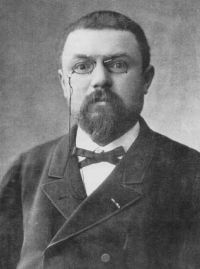
Portrait of Henri Poincaré Henri Poincaré Translation:Two Papers of Henri Poincaré on Mathematical Physics (1921)

We can thus say that the probability ω is entirely given as soon as we know the distribution of energy for all temperatures. There is only one function ω for a distributions which is given as a function of the temperature. Consequently, the assumptions that we made on ω and which lead to the law of Planck are the only ones that we can admit.
That is the reasoning by which Poincaré established the necessity of the quantum hypothesis.
We see that the conclusion depends on the assumption that Planck's formula is an accurate image of reality.
Source: Wikisource

Portrait of Henri Poincaré Henri Poincaré Translation:Two Papers of Henri Poincaré on Mathematical Physics (1921)

Poincaré notices, for example, if x, y, z and are considered as the coordinates of a point in four-dimensional space, the transformations of relativity are reduced to rotations in this space. He also had the idea of adding to the three force-components X, Y, Z the magnitude
which is nothing but the work of the force per unit time and which we can (to some extent) regard as a fourth component. When we ask after the force that a body experiences per unit volume, the magnitudes X, Y, Z, T are affected by a transformation of relativity in the same way as the magnitudes x, y, z, t.
Source: Wikisource

Portrait of Henri Poincaré Henri Poincaré Translation:Two Papers of Henri Poincaré on Mathematical Physics (1921)

When, in the applications of the probability theory to the molecular theories, we seek the state of a system that presents the maximum of probability, we always find that, thanks to the immense number of the molecules, this maximum is so pronounced that one can neglect the probability of all the states which deviate appreciably from the most probable state.
Source: Wikisource

Get perspective with Kwize: daily news enlightened by great literature