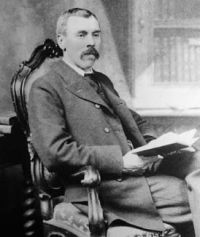
Henry Frederick Baker

Henry Frederick Baker

Summary

Portrait of Henry Frederick Baker Henry Frederick Baker 1911 Encyclopædia Britannica, Volume 8… (1911)

The central discovery of the transformation theory of the solution of an equation F (x, y, z, dz/dx, dz/dy) = 0 is that its solution can always be reduced to the solution of partial equations which are linear. For this, however, we must regard dz/dx, dz/dy, during the process of integration, not as the differential coefficients of a function z in regard to x and y, but as variables independent of x, y, z, the too great indefiniteness that might thus appear to be introduced being provided for in another way.
Source: Wikisource

Portrait of Henry Frederick Baker Henry Frederick Baker 1911 Encyclopædia Britannica, Volume 8… (1911)

When the linear differential equation, which we take to be of the second order, has variable coefficients, though there is no general rule for obtaining a solution in finite terms, there are some results which it is of advantage to have in mind. We have seen that if one solution of the equation obtained by putting the right side zero, say y1, be known, the equation can be solved.
Source: Wikisource

Portrait of Henry Frederick Baker Henry Frederick Baker 1911 Encyclopædia Britannica, Volume 8… (1911)

We rely, in fact, upon the theory of monogenic analytical functions (see Function) , a function being determined entirely by its development in the neighbourhood of one set of values of the independent variables, from which all its other values arise by continuation; it being of course understood that the coefficients in the differential equations are to be continued at the same time. But it is to be remarked that there is no ground for believing, if this method of continuation be utilized, that the function is single-valued
Source: Wikisource

Get perspective with Kwize: daily news enlightened by great literature