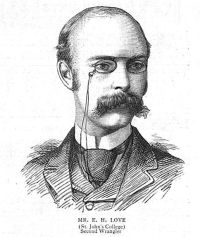
 Augustus Edward Hough Love,
1911 Encyclopædia Britannica, Volume 27…
(1911)
Augustus Edward Hough Love,
1911 Encyclopædia Britannica, Volume 27…
(1911)
“ Euler had been under the necessity of resolving an integral into a sum of elements, recording the magnitude of the change produced in each element by a slight change in the unknown function, and thence forming an expression for the total change in the sum under consideration. Lagrange proposed to free the theory from this necessity. Euler had allowed such changes in the position of the curve, along which the integral, to be made a maximum or minimum, is taken, as can be produced by displacement parallel to the axis of ordinates. ”
