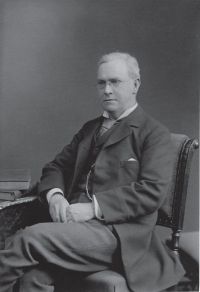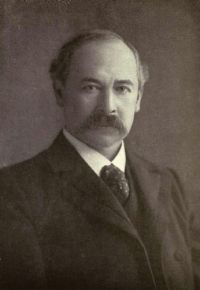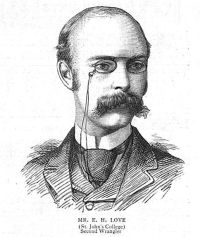
Augustus Edward Hough Love

Biographical details

Portrait of Augustus Edward Hough Love Augustus Edward Hough Love,  1911 Encyclopædia Britannica (1911)

“ Stress.—Every body that we know anything about is always under the action of forces. Every body upon which we can experiment is subject to the force of gravity, and must, for the purpose of experiment, be supported by other forces. Such forces are usually applied by way of pressure upon a portion of the surface of the body; and such pressure is exerted by another body in contact with the first. The supported body exerts an equal and opposite pressure upon the supporting body across the portion of surface which is common to the two. ”
Source: Wikisource

Portrait of Augustus Edward Hough Love Augustus Edward Hough Love,  1911 Encyclopædia Britannica (1911)

“ Limits of Elasticity.—A solid body which has been strained by considerable forces does not in general recover its original size and shape completely after the forces cease to act. The strain that is left is called set. If set occurs the elasticity is said to be “imperfect,” and the greatest strain (or the greatest load) of any specified type, for which no set occurs, defines the “limit of perfect elasticity” corresponding to the specified type of strain, or of stress. ”
Source: Wikisource

Portrait of Augustus Edward Hough Love Augustus Edward Hough Love,  1911 Encyclopædia Britannica, Volume 27… (1911)

“ Euler had been under the necessity of resolving an integral into a sum of elements, recording the magnitude of the change produced in each element by a slight change in the unknown function, and thence forming an expression for the total change in the sum under consideration. Lagrange proposed to free the theory from this necessity. Euler had allowed such changes in the position of the curve, along which the integral, to be made a maximum or minimum, is taken, as can be produced by displacement parallel to the axis of ordinates. ”
Source: Wikisource

Get perspective with Kwize: daily news enlightened by great literature