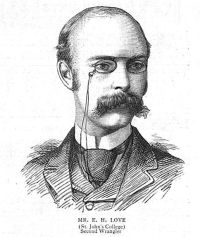
Augustus Edward Hough Love

Augustus Edward Hough Love

Summary

Portrait of Augustus Edward Hough Love Augustus Edward Hough Love 1911 Encyclopædia Britannica (1911)

Stress.—Every body that we know anything about is always under the action of forces. Every body upon which we can experiment is subject to the force of gravity, and must, for the purpose of experiment, be supported by other forces. Such forces are usually applied by way of pressure upon a portion of the surface of the body; and such pressure is exerted by another body in contact with the first. The supported body exerts an equal and opposite pressure upon the supporting body across the portion of surface which is common to the two.
Source: Wikisource

Portrait of Augustus Edward Hough Love Augustus Edward Hough Love 1911 Encyclopædia Britannica (1911)

Limits of Elasticity.—A solid body which has been strained by considerable forces does not in general recover its original size and shape completely after the forces cease to act. The strain that is left is called set. If set occurs the elasticity is said to be “imperfect,” and the greatest strain (or the greatest load) of any specified type, for which no set occurs, defines the “limit of perfect elasticity” corresponding to the specified type of strain, or of stress.
Source: Wikisource

Portrait of Augustus Edward Hough Love Augustus Edward Hough Love 1911 Encyclopædia Britannica (1911)

It is a familiar fact that the hair-spring of a watch can be coiled and uncoiled millions of times a year for several years without losing its elasticity; yet the same spring can have its shape permanently altered by forces which are much greater than those to which it is subjected in the motion of the watch. The incompleteness of the recovery from the effects of great forces is as important a fact as the practical completeness of the recovery from the effects of comparatively small forces.
Source: Wikisource

Get perspective with Kwize: daily news enlightened by great literature