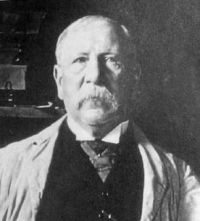
Alfred George Greenhill

Alfred George Greenhill

Summary

Portrait of Alfred George Greenhill Alfred George Greenhill 1911 Encyclopædia Britannica (1911)

The Different States of a Substance or Matter.—All substance in nature falls into one of the two classes, solid and fluid; a solid substance, the land, for instance, as contrasted with a fluid, like water, being a substance which does not flow of itself.
A fluid, as the name implies, is a substance which flows, or is capable of flowing; water and air are the two fluids distributed most universally over the surface of the earth.
Fluids again are divided into two classes, termed a liquid and a gas, of which water and air are the chief examples.
Source: Wikisource

Portrait of Alfred George Greenhill Alfred George Greenhill 1911 Encyclopædia Britannica (1911)

Definition of a Fluid.—A fluid is a substance which yields continually to the slightest tangential stress in its interior; that is, it can be divided very easily along any plane (given plenty of time if the fluid is viscous) . It follows that when the fluid has come to rest, the tangential stress in any plane in its interior must vanish, and the stress must be entirely normal to the plane. This mechanical axiom of the normality of fluid pressure is the foundation of the mathematical theory of hydrostatics.
Source: Wikisource

Portrait of Alfred George Greenhill Alfred George Greenhill 1911 Encyclopædia Britannica (1911)

Dubuat considered that if water were a perfect fluid, and the channels in which it flowed infinitely smooth, its motion would be continually accelerated, like that of bodies descending in an inclined plane. But as the motion of rivers is not continually accelerated, and soon arrives at a state of uniformity, it is evident that the viscosity of the water, and the friction of the channel in which it descends, must equal the accelerating force.
Source: Wikisource

Get perspective with Kwize: daily news enlightened by great literature