Golf

Definition and stakes

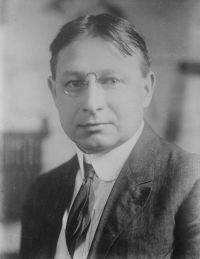
Portrait of Eleanor Hoyt Brainerd Eleanor Hoyt Brainerd In Vanity Fair: A Tale of Frocks and Femininity

Incidentally golf is played, and real golfers, enjoying the beautiful course and the perfect greens, bless the day when golf became a Parisian fad, and look tolerantly at the goodly collection of dukes and counts and princes and bankers and diplomats who sit in the shade of the big bungalow during the long golden afternoon, drinking Scotch whiskey and soda,—as a concession to the genius loci,—and watching with a certain amused wonder the scattered figures toiling around the links in the glare of the sun.
Source: Gutenberg

Various Harper's Round Table, May 5, 1896

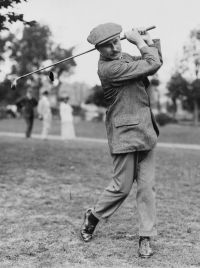
All golf is divided into three parts—driving, approaching, and holing out—and of these three, driving, or free hitting, either with wood or iron, is by far the most pleasing. It is a delightful sensation to feel the ball slip away almost by itself as the club head swings through, and then to watch it describing its graceful curve of, say, one hundred and fifty yards through the air, or skimming like a swallow, straight and low over that dreaded bunker. Without driving, indeed, there would be very little golf, and happy is the man who may always count upon being both far and sure.
Source: Gutenberg

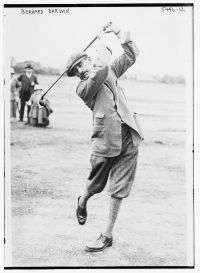
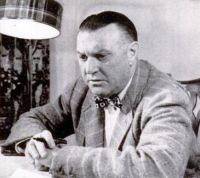
Portrait of Bernard Darwin Bernard Darwin The Golf Courses of the British Isles

Now we come to the links of the Royal Blackheath Golf Club, which is very justly proud of the fact that it was instituted in 1608. That is indeed a great record, and, as we hack our ball along with a driving mashie out of a hard and flinty lie, narrowly avoiding the slaughter of a passing pedestrian, we feel that we are on hallowed ground. Moreover, though we may speak flippantly of the bad lies and the numerous live hazards on the course, the golf is good golf—far better and more searching than is to be found on many smoothly shaven lawns covered with artificial ramparts.
Source: Gutenberg

Get perspective with Kwize: daily news enlightened by great literature