Vortex

Definition and stakes

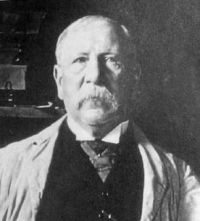
Andrew Gray,  Lord Kelvin: An account of his scientific life and work

“ In this case the velocity of each particle of the water is proportional to its distance from the axis, and the whole mass, when relative equilibrium is set up, turns, as if it were rigid, about the axis of the vessel. Each element of the fluid in this "forced vortex," as it is called, is in rotation, and, like the moon, makes one turn in one revolution about the centre of its path. This is, therefore, a true, though very simple, case of vortex-motion. ”
Source: Gutenberg

Thomas Bassnett,  Outlines of a Mechanical Theory of Storms

“ The vortex is a fluid, through which the moon freely wends her way, passing through the equatorial plane of the vortex twice in each revolution. These points constitute the moon’s nodes on the plane of the vortex, and, from the principles laid down, the force of the moon to disturb the equilibrium of the axis of the vortex, vanishes at these points, and attains a maximum 90° from them. ”
Source: Gutenberg

Andrew Gray,  Lord Kelvin: An account of his scientific life and work

“ Whether the surface is infinite or not, the vortex is spread out into what is called a vortex-sheet, that is, in a surface on the two sides of which the fluid moves with different tangential velocities.
Through a vortex-ring or tube, the fluid circulates in closed lines of flow, each one of which is laced through the tube. The circulation along every line of flow which encloses the same system of vortex-tubes has the same value.
”
Source: Gutenberg

Get perspective with Kwize: daily news enlightened by great literature