Summary

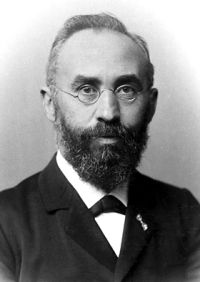
Portrait of Hendrik Lorentz Hendrik Lorentz Translation:Attempt of a Theory of Electrical and Optical Phenomena in Moving Bodies (1895)

Indeed, why should we, since we assumed that the aether is not in motion, ever speak about a force acting on that medium? The most simple would by, to assume that on a volume element of the aether, considered as a whole, never acts a force, or even refuse to apply the concept of force on such an element that of course never moves from its place. Of course this view violates the equality of action and reaction —, since we have reason to say that the aether exerts forces on ponderable matter
Source: Wikisource

Portrait of Hendrik Lorentz Hendrik Lorentz Translation:Attempt of a Theory of Electrical and Optical Phenomena in Moving Bodies (1895)

Strictly speaking, not a single experiment in which a charged body or a current conductor moves, can be handled carefully, if the state of motion of the aether is not considered at the same time. In any phenomenon of electricity, the question arises whether an influence of the earth's motion is to be expected; and regarding the consequences of the latter for optical phenomena, we have to demand from the electro-magnetic theory of light that it can account for the already established facts.
Source: Wikisource

Portrait of Hendrik Lorentz Hendrik Lorentz Translation:Attempt of a Theory of Electrical and Optical Phenomena in Moving Bodies (1895)

From ordinary electrostatics, we know for example that an excess of positive (or negative) ions can be distributed over a conductor, namely over its surface , so that in the interior no electric force is acting. If we take this distribution for the system and derive from it a system by the above-discussed transformation, then also in this one an excess of positive ions only exists at a certain surface , while in all interior points the electric force vanishes. The fact that an electric charge is located at the surface of a conductor, won't be changed by the translation of ponderable matter.
Source: Wikisource

Get perspective with Kwize: daily news enlightened by great literature