Summary

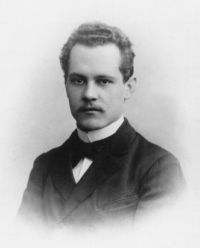
Portrait of Arnold Sommerfeld Arnold Sommerfeld On the Theory of Relativity II: Four-dimensional Vector Analysis

As one directly obtains (in ordinary vector calculus) the theorems of Gauss and Stokes from the concept of div and rot, and Green's theorem is supplemented to that of Gauss by means of the concept of grad, one also will obtain three integral theorems from the concepts of scalar and vectorial divergence and rotation, which we will denote as theorem of Gauss, Gauss-Stokes, and Stokes; there, the "Gauss-Stokes theorem" stands in the middle between the actual theorem of Gauss and Stokes, in the same way as the concept of vector divergence stands between that of scalar divergence and rotation.
Source: Wikisource

Portrait of Arnold Sommerfeld Arnold Sommerfeld On the Theory of Relativity II: Four-dimensional Vector Analysis

The theorem of Stokes. If means an closed one-dimensional convolution (arbitrarily located in the world) , a two-times extended surface limited by , a four-vector, then Stokes' theorem is given as a direct consequence of definition equation (21) in the location and order of directions in the form
One can remark, that one cannot speak (even with respect to the ordinary three-dimensional formulation of Stokes' theorem) , as it usually happens, of the normal component, but of the tangential component of rotation, since rotation is also at that place a vector of second kind.
Source: Wikisource

Portrait of Arnold Sommerfeld Arnold Sommerfeld On the Theory of Relativity II: Four-dimensional Vector Analysis

Based on the world-line of a certain charge element (see Fig. 4) we denote the point of the world-line, which is cut by a cone constructed at point , with Minkowski as light-point of . Its coordinates are unequivocally determined when the charge element never moves at superluminal velocity, and the fourth coordinate can be determined, as previously shown, by equation . As it is known, it says that a light signal emanating from world-point , reaches world-point (i.e. it reaches the space-point at time ) .
Source: Wikisource

Get perspective with Kwize: daily news enlightened by great literature