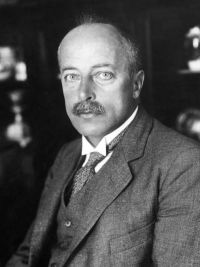
Arnold Sommerfeld

Portrait of Arnold Sommerfeld Arnold Sommerfeld,  An Objection Against the Theory of Relativity of Electrodynamics and its Removal

“ If I think of the number of waves as more and more enlarged, then I get a finite wave train that I can consider as a signal. An actually infinite wave is traveling with superluminal velocity (Sommerfeld: only the phase, not the energy) . If I have a very long wave train that is limited, then it should travel only with the speed of light and that is not clear to me. I want to ask after the propagation velocity of the wave that is in the middle. If the train is actually infinite in length, then it travels with superluminal velocity ”
Source: Wikisource

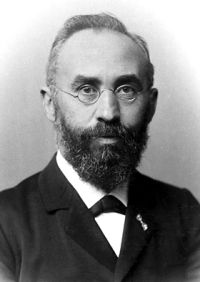
Portrait of Arnold Sommerfeld Arnold Sommerfeld,  On the Theory of Relativity II: Four-dimensional Vector Analysis

“ As one directly obtains (in ordinary vector calculus) the theorems of Gauss and Stokes from the concept of div and rot, and Green's theorem is supplemented to that of Gauss by means of the concept of grad, one also will obtain three integral theorems from the concepts of scalar and vectorial divergence and rotation, which we will denote as theorem of Gauss, Gauss-Stokes, and Stokes; there, the "Gauss-Stokes theorem" stands in the middle between the actual theorem of Gauss and Stokes, in the same way as the concept of vector divergence stands between that of scalar divergence and rotation. ”
Source: Wikisource

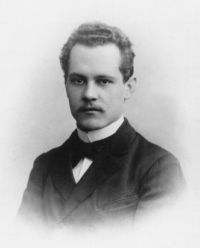
Portrait of Arnold Sommerfeld Arnold Sommerfeld,  On the Theory of Relativity I: Four-dimensional Vector Algebra

“ Component formation into arbitrary directions and planes, and its connection with the Lorentz transformation. It's characteristic for the vector-concept and its independence of the coordinate system, that we can speak of its components into arbitrary directions (planes as regards the six-vector) . By the component of a four-vector into the -axis we have to think of the perpendicular projection upon this axis, i.e.
If is a "space-like" axis, then [10] , , become real, becomes purely imaginary, so that (see (1) and 7) ) becomes real.
”
Source: Wikisource

Get perspective with Kwize: daily news enlightened by great literature