Horace Lamb

Biographical details

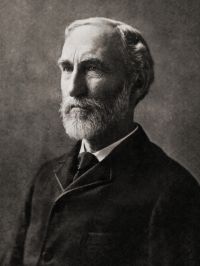
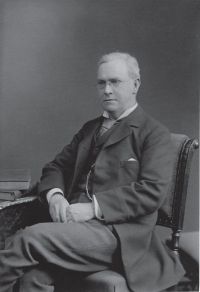
Portrait of Horace Lamb Horace Lamb,  1911 Encyclopædia Britannica, Volume 17… (1911)

“ An important conclusion is that in any displacement of a system of bodies in equilibrium, such that the virtual work of all forces except gravity may be ignored, the depth of the centre of gravity is “stationary.”
The question as to stability of equilibrium belongs essentially to kinetics; but we may state by anticipation that in cases where gravity is the only force which does work, the equilibrium of a body or system of bodies is stable only if the depth of the centre of gravity be a maximum.
”
Source: Wikisource

Portrait of Horace Lamb Horace Lamb,  1911 Encyclopædia Britannica, Volume 17… (1911)

“ We proceed to sketch the theory of the finite displacements of a rigid body. It was shown by Euler (1776) that any displacement in which one point O of the body is fixed is equivalent to a pure rotation about some axis through O. Imagine two spheres of equal radius with O as their common centre, one fixed in the body and moving with it, the other fixed in space. ”
Source: Wikisource

Portrait of Horace Lamb Horace Lamb,  1911 Encyclopædia Britannica (1911)

“ The first, which we have called the wave method, exhibits the solution in the form containing an arbitrary function, the nature of which must be determined from the initial conditions. The second, or harmonic method, leads to a series of terms involving sines and cosines, the coefficients of which have to be determined. The harmonic method may be defined in a more general manner as a method by which the solution of any actual problem may be obtained as the sum or resultant of a number of terms, each of which is a solution of a particular case of the problem. ”
Source: Wikisource

Get perspective with Kwize: daily news enlightened by great literature