Summary

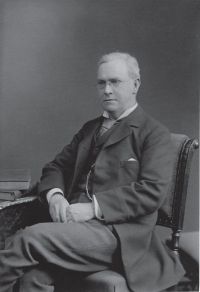
Portrait of Horace Lamb Horace Lamb 1911 Encyclopædia Britannica, Volume 8… (1911)

Since the total energy of the system at any instant is given (in the notation of § 5) by an expression of the form , where cannot be negative, the argument of Thomson and Tait, given under Mechanics, § 23, for the statical question, shows that it is a necessary as well as a sufficient condition for secular stability that should be a minimum. When a system is “ordinarily” stable, but “secularly” unstable, the operation of the frictional forces is to induce a gradual increase in the amplitude of the free vibrations which are called into play by accidental disturbances.
Source: Wikisource

Portrait of Horace Lamb Horace Lamb 1911 Encyclopædia Britannica, Volume 8… (1911)

The small oscillations of a conservative system about a configuration of equilibrium, and the criterion of stability, are discussed in Mechanics, § 23. The question of the stability of given types of motion is more difficult, owing to the want of a sufficiently general, and at the same time precise, definition of what we mean by “stability.”
Source: Wikisource

Portrait of Horace Lamb Horace Lamb 1911 Encyclopædia Britannica, Volume 8… (1911)

It appears that from the point of view of the theory of small oscillations it is not essential, and that there may even be stability when is a maximum. The precise conditions, which are of a somewhat elaborate character, have been formulated by Routh. An important distinction has, however, been established by Thomson and Tait, and by Poincaré, between what we may call ordinary or temporary stability (which is stability in the above sense) and permanent or secular stability, which means stability when regard is had to possible dissipative forces called into play whenever the co-ordinates vary.
Source: Wikisource

Get perspective with Kwize: daily news enlightened by great literature