Geodesic

Definition and stakes

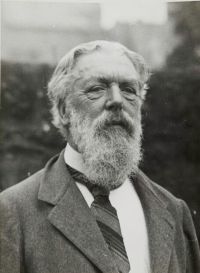
Portrait of Robert Stawell Ball Robert Stawell Ball,  Encyclopædia Britannica, Ninth Edition (1883)

“ A doubly infinite number of geodesic surfaces can be drawn through every point. If a rigid body be divided into two parts by a geodesic plane, then no matter how the body be displaced the plane of section will still be geodesic. The plane of section may be made to pass through any point, and the body may then be given such an aspect as shall cause the section to coincide with any geodesic surface through the point, but this necessarily involves that the section shall fit each geodesic surface, in other words, that all the geodesic surfaces shall have a constant curvature. ”
Source: Wikisource

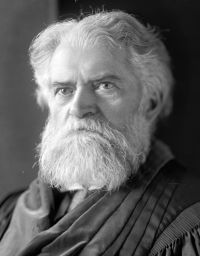
Portrait of Bertrand Russell Bertrand Russell,  The A B C of Relativity (1925)

“ We saw that a geodesic on a surface is the shortest line that can be drawn on the surface from one point to another; for example, on the earth the geodesics are great circles. When we come to space-time, the mathematics is the same, but the verbal explanations have to be rather different. In the general theory of relativity, it is only neighboring events that have a definite interval, independently of [Pg 122] the route by which we travel from one to the other. ”
Source: Gutenberg

Aram D'Abro,  The evolution of scientific thought from Newton to Einstein (1927)

“ But if, for some reason or other, the free fall of the body is interfered with, if, for instance, the rigidity of the earth’s crust prevents the body from falling farther along the geodesic, the geodesic will react and will strive to force the body through the earth’s crust. It was this force which we formerly ascribed to the pull of gravitation. ”
Source: Gutenberg

Get perspective with Kwize: daily news enlightened by great literature