Summary

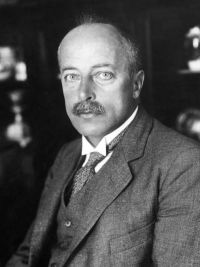
Portrait of Max von Laue Max von Laue The Principle of Relativity

We are allowed to define the term "clock" as far as at page 108, i.e. all physical, chemical, and biological processes must show in their course the same dilatation. A life form in motion is less aging, and even the thought process of a man must occur slower, when the relativity principle shall be correct. However, he won't experience anything of this, as long as his velocity is not changing, since he is also at rest in a valid reference system. On the contrary, he will believe with some justification, that he thinks faster than the men who are moving with respect to him.
Source: Wikisource

Portrait of Max von Laue Max von Laue The Principle of Relativity

We know of only two different actions propagating through vacuum, gravitation and electromagnetic processes. About the propagation of the first one we know nothing else than that its velocity is very great against astronomical velocities. That it is greater than the speed of light, although it is often claimed, finds no support in experience. Much better is our knowledge of the law of light propagation in vacuum, since it is proven by Michelson's experiment (with a precision which is hardly attained in other physical measurements) that it is equal in all directions with respect to all systems.
Source: Wikisource

Portrait of Max von Laue Max von Laue The Principle of Relativity

If one arrives by a different choice at different results, then all laws wouldn't be invariable with respect to the same transformation, thus the relativity principle would be wrong. Evidently, such laws related to physical processes in empty space, are the most simple ones. Since in the other ones, the velocity of matter relative to the references system is included in its mathematical formulation, and must be co-transformed by a transformation; in vacuum, however, were we know nothing about moving things, this complication vanishes.
Source: Wikisource

Get perspective with Kwize: daily news enlightened by great literature