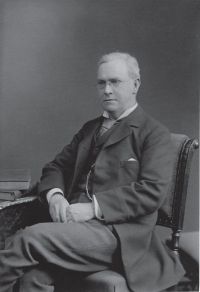
Horace Lamb

Horace Lamb

Summary

Portrait of Horace Lamb Horace Lamb 1911 Encyclopædia Britannica (1911)

The first, which we have called the wave method, exhibits the solution in the form containing an arbitrary function, the nature of which must be determined from the initial conditions. The second, or harmonic method, leads to a series of terms involving sines and cosines, the coefficients of which have to be determined. The harmonic method may be defined in a more general manner as a method by which the solution of any actual problem may be obtained as the sum or resultant of a number of terms, each of which is a solution of a particular case of the problem.
Source: Wikisource

Portrait of Horace Lamb Horace Lamb 1911 Encyclopædia Britannica (1911)

In other words, no part of the energy depends on the product of the amplitudes of two different harmonics. When two modes of motion of the same system are conjugate to each other, the existence of one of them does not affect the other.
The simplest case of harmonic analysis, that of which the treatment of the vibrating string is an example, is completely investigated in what is known as Fourier’s theorem.
Source: Wikisource

Portrait of Horace Lamb Horace Lamb 1911 Encyclopædia Britannica (1911)

Finally, it may be noticed that the conditions of wave-propagation without change of type may be investigated in another manner. If we impress on the whole medium a velocity equal and opposite to that of the wave we obtain a “steady” or “stationary” state in which the circumstances at any particular point of space are constant. Thus in the case of the vibrations of an inextensible string we may, in the first instance, imagine the string to run through a fixed smooth tube having the form of the wave.
Source: Wikisource

Get perspective with Kwize: daily news enlightened by great literature