“ If any one would ask how a Medium can be so rare, let him tell me how the Air, in the upper parts of the Atmosphere, can be above an hundred thousand thousand times rarer than Gold. Let him also tell me, how an electrick Body can by Friction emit an Exhalation so rare and subtile, and yet so potent, as by its Emission to cause no sensible Diminution of the weight of the electrick Body, and to be expanded through a Sphere, whose Diameter is above two Feet, and yet to be able to agitate and carry up Leaf Copper, or Leaf Gold, at the distance of above a Foot from the electrick Body? ”
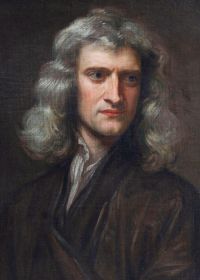
Isaac Newton
Summary

Published in 1704, Isaac Newton’s Opticks is a seminal scientific treatise exploring the nature of light, color, and optical phenomena through meticulous experimentation. Moving beyond geometric optics, Newton’s work challenges Aristotelian ideas of light as white by demonstrating its spectral composition via prisms, establishing color as a perceptual experience rather than an intrinsic characteristic.
The text, organized around empirical investigation, also delves into speculative questions on gravity, heat, and matter, anticipating later scientific developments. Its combination of rigorous experimentation and philosophical reflection solidified its role as a cornerstone of the Scientific Revolution.
Quotes from Opticks (Isaac Newton)
“ The homogeneal Light and Rays which appear red, or rather make Objects appear so, I call Rubrifick or Red-making; those which make Objects appear yellow, green, blue, and violet, I call Yellow-making, Green-making, Blue-making, Violet-making, and so of the rest. And if at any time I speak of Light and Rays as coloured or endued with Colours, I would be understood to speak not philosophically and properly, but grossly, and accordingly to such Conceptions as vulgar People in seeing all these Experiments would be apt to frame. For the Rays to speak properly are not coloured. ”
“ And yet we are not to consider the World as the Body of God, or the several Parts thereof, as the Parts of God. He is an uniform Being, void of Organs, Members or Parts, and they are his Creatures subordinate to him, and subservient to his Will; and he is no more the Soul of them, than the Soul of Man is the Soul of the Species of Things carried through the Organs of Sense into the place of its Sensation, where it perceives them by means of its immediate Presence, without the Intervention of any third thing. ”
