Summary

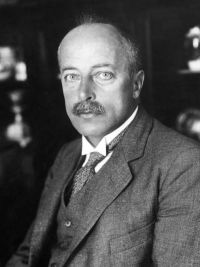
Portrait of Max von Laue Max von Laue An Example Concerning the Dynamics of the Theory of Relativity

We can compare its field with an angle-lever, its material parts with the shell. Neither the electromagnetic momentum of one part, nor the mechanical momentum of the other part, is parallel to the velocity, therefore both need a torque for their translatory motion. However, since momentum as a whole is parallel to velocity, both momentum components (perpendicular to the velocity) are oppositely equal to one another, and the same holds thus for the torque.
Source: Wikisource

Portrait of Max von Laue Max von Laue An Example Concerning the Dynamics of the Theory of Relativity

The totality doesn't require any torque, it rather represents (as in the model consisting of angle-lever and shell) a "completely static system" [10] , which obeys the dynamics of the mass-point for stationary and quasi-stationary translatory motions.
That the momentum of the angle-lever has not the direction of its velocity, is also given by another consequence, which appears to be paradox in Newton's dynamics.
Source: Wikisource

Portrait of Max von Laue Max von Laue An Example Concerning the Dynamics of the Theory of Relativity

In general, the increase of angular momentum is
[7]
by which the fact can be confirmed again, that the component of (parallel to ) doesn't matter.
Eventually, we imagine that the lever is in a shell, at which an axis of rotation is mounted, and from which – for example by strained springs – forces and are exerted. The energy current considered above, is continued in the axis after it left the lever at , then it enters the shell through the mounting locations of the axes, from there it enters the spring which affects the lever at , and thus it is closed.
Source: Wikisource

Get perspective with Kwize: daily news enlightened by great literature