Summary

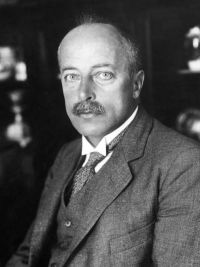
Portrait of Max von Laue Max von Laue On the Theory of the Experiment of Trouton and Noble

The subject of the experiment is the question, whether a charged plate condenser experiences a torque due to its motion with Earth. Relativity and absolute theory accordingly are affirming this; of course, relativity theory does this only in the case of a non-co-moving reference system ; in the "rest system" there is no torque. With the absolute theory, we can now expect a rotation in consequence of the torque, since its dynamics is that of Newton; according to this theory, the condenser tries to locate itself, so that the direction of velocity is tangential to the plates.
Source: Wikisource

Portrait of Max von Laue Max von Laue On the Theory of the Experiment of Trouton and Noble

First we calculate the forces exerted upon the resting condenser. Attraction is the by far strongest force-action exerted by the plates upon each other; it has (as far as the field in the interior can be considered as homogeneous) the strength per unit area, when is the field strength. If we neglect the marginal effects, then these forces produce the resultants of strength
whose points of contact are the midpoints of the plates. Far less strong, but still useful for our purposes, are the traction-forces acting at the rim of the plates.
Source: Wikisource

Portrait of Max von Laue Max von Laue On the Theory of the Experiment of Trouton and Noble

If we would extend our investigation to this case, we would be faced with great mathematical difficulties, because one cannot use the solution of Helmholtz (section III) for the potential function at the rim any more. Our result can only qualitatively be transferred, so that forces are acting at the rim and the boundary of the dielectric (besides the attraction of the plates) which are tangentially stressing the plates in the state of rest, so that the totality of these forces produces the torque in the case of motion.
Source: Wikisource

Get perspective with Kwize: daily news enlightened by great literature