Summary

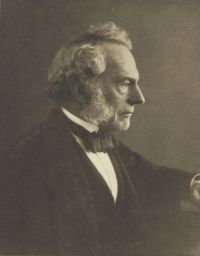
Portrait of George Gabriel Stokes George Gabriel Stokes On Fresnel's Theory of the Aberration of Light (1846)

Also, instead of considering the earth as in motion and the æther outside it as at rest, it will be simpler to conceive a velocity equal and opposite to that of the earth impressed both on the earth and on the æther. On this supposition the earth will be at rest; the æther outside it will be moving with a velocity , and the æther in a refracting medium with a velocity , in a direction contrary to that of the earth's real motion. On account of the smallness of the coefficient of aberration, we may also neglect the square of the ratio of the earth's velocity to that of light
Source: Wikisource

Portrait of George Gabriel Stokes George Gabriel Stokes On Fresnel's Theory of the Aberration of Light (1846)

THE theory of the aberration of light, and of the absence of any influence of the motion of the earth on the laws of refraction, &c., given by Fresnel in the ninth volume of the Annales de Chimie, p. 57, is really very remarkable. If we suppose the diminished velocity of propagation of light within refracting media to arise solely from the greater density of the æther within them, the elastic force being the same as without, the density which it is necessary to suppose the æther within a medium of refractive index to have is , the density in vacuum being taken for unity.
Source: Wikisource

Portrait of George Gabriel Stokes George Gabriel Stokes On Fresnel's Theory of the Aberration of Light (1846)

All these results would follow immediately from the theory of aberration which I proposed in the July number of this Magazine; nor have I been able to obtain any result, admitting of being compared with experiment, which would be different according to which theory we adopted. This affords a curious instance of two totally different theories running parallel to each other in the explanation of phænomena.
Source: Wikisource

Get perspective with Kwize: daily news enlightened by great literature