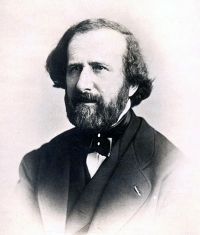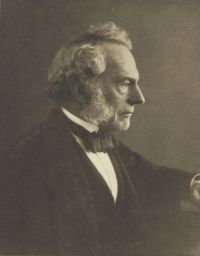
George Gabriel Stokes

Portrait of George Gabriel Stokes George Gabriel Stokes,  On the Constitution of the Luminiferous Æther… (1846)

“ Before considering the motion of the earth and the æther, let us take the case of a solid moving in an ordinary incompressible fluid, which may be supposed to be infinitely extended in all directions about the solid. If we suppose the solid and fluid to be at first at rest, and the solid to be then moved in any manner, it follows from the three first integrals of the ordinary equations of fluid motion, obtained by M. Cauchy, that the motion of the fluid at any time will be such that (a.) is an exact differential. ”
Source: Wikisource

Portrait of George Gabriel Stokes George Gabriel Stokes,  On the Constitution of the Luminiferous Æther (1848)

“ When, however, we consider the wonderful simplicity of the explanations of the phænomena of polarization when we adopt the theory of transversal vibrations, and the difficulty, which to me at least appears quite insurmountable, of explaining these phænomena by any vibrations due to the condensation and rarefaction of an elastic fluid such as air, it seems reasonable to suspend our judgement, and be content to learn from phænomena the existence of forces which we should not beforehand have expected. ”
Source: Wikisource

Portrait of George Gabriel Stokes George Gabriel Stokes,  On the Aberration of Light (1845)

“ Hence the angle must be very much greater for the moon than for any other body of the solar system; for in the case of the planets the value of is in no instance double its value for the earth or moon, while their discs are very small compared with that of the moon; and in the case of the sun, although its disc is about as large as that of the moon, its velocity round the centre of gravity of the solar system is very small. ”
Source: Wikisource

Get perspective with Kwize: daily news enlightened by great literature