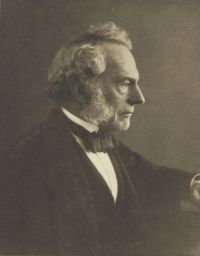
George Gabriel Stokes

George Gabriel Stokes

Summary

Portrait of George Gabriel Stokes George Gabriel Stokes On the Aberration of Light (1845)

In considering the effect of aberration on a planet, it will be convenient to divide the integrations in equation (5.) into three parts, first integrating from the point considered on the surface of the planet to a distance at which the motion of the æther may be neglected, then to a point near the earth where we may still neglect the motion of the æther, and lastly to the point of the earth's surface at which the planet is viewed. For the first part we shall have , and will be the resolved parts of the planet's velocity.
Source: Wikisource

Portrait of George Gabriel Stokes George Gabriel Stokes On the Aberration of Light (1845)

Hence the angle must be very much greater for the moon than for any other body of the solar system; for in the case of the planets the value of is in no instance double its value for the earth or moon, while their discs are very small compared with that of the moon; and in the case of the sun, although its disc is about as large as that of the moon, its velocity round the centre of gravity of the solar system is very small.
Source: Wikisource

Portrait of George Gabriel Stokes George Gabriel Stokes On the Aberration of Light (1845)

The curvature at will have the same effect on the apparent position of the planet as it would have on that of a star in the same direction : as to the curvature at , if we draw perpendicular to produced, the curvature will have the effect of causing to be seen as if it were at . Now the angle between the tangents at and being that through which a star in the direction of is displaced by aberration to an observer at , and the distance being by hypothesis small (two or three radii of the planet suppose) , it follows that the angle is extremely small, and may be neglected.
Source: Wikisource

Get perspective with Kwize: daily news enlightened by great literature