Summary

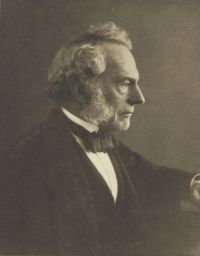
Portrait of George Gabriel Stokes George Gabriel Stokes On the Constitution of the Luminiferous Æther… (1846)

Before considering the motion of the earth and the æther, let us take the case of a solid moving in an ordinary incompressible fluid, which may be supposed to be infinitely extended in all directions about the solid. If we suppose the solid and fluid to be at first at rest, and the solid to be then moved in any manner, it follows from the three first integrals of the ordinary equations of fluid motion, obtained by M. Cauchy, that the motion of the fluid at any time will be such that (a.) is an exact differential.
Source: Wikisource

Portrait of George Gabriel Stokes George Gabriel Stokes On the Constitution of the Luminiferous Æther… (1846)

If, instead of supposing the solid to move continueously, we supposed it first to be in motion for a very small interval of time, then to be at rest for another equal interval, then to be in motion for a third interval equal to the former, and so on alternately, theoretically the fluid ought to be at rest at the expiration of the first, third, &c.
Source: Wikisource

Portrait of George Gabriel Stokes George Gabriel Stokes On the Constitution of the Luminiferous Æther… (1846)

In that paper I supposed that the æther close to the surface of the earth was at rest relatively to the earth; in fact, the very object of the paper was to get rid of the apparent necessity of supposing the æther to pass through the whole atmosphere and through the earth itself. It should be observed, however, that the phænomenon of aberration allows us to suppose that the æther passes through the atmosphere and through the earth with any velocity, either constant, or varying from point to point, provided only (a.) be an exact differential.
Source: Wikisource

Get perspective with Kwize: daily news enlightened by great literature