Summary

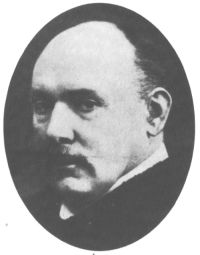
Portrait of Alfred Bucherer Alfred Bucherer Translation:Measurements of Becquerel rays (1908)

The rigid electron is in my view a monster when put together with Maxwell's equations, whose innermost harmony is the relativity principle. When one approaches Maxwell's equations on the basis of the idea of the rigid electron, then it just appears to me, as if one goes into a concert and one has plugged ones ears with cotton. One has to admire in the highest the courage and the force of the school of the rigid electron, which jumps over the widest mathematical hurdles with a fabulous approach, in the hope to fall upon experimental ground at the other side.
Source: Wikisource

Portrait of Alfred Bucherer Alfred Bucherer Translation:Measurements of Becquerel rays (1908)

All dimensions, which coincide with the direction of motion, are contracted in the ratio , where means the ratio of the body's velocity to the speed of light. Then it was shown by Einstein, that one arrives at the exact same experimental consequences, when "local time" as introduced by Lorentz, is defined as time per se, and at the same time the space coordinates in Maxwell's equations are so transformed, that they are in agreement with this definition of time. The relativity principle is clearly emphasized in Einstein's version.
Source: Wikisource

Portrait of Alfred Bucherer Alfred Bucherer Translation:Measurements of Becquerel rays (1908)

After leaving the condenser, the magnetic field alone acts upon the rays. The deflected electrons fall upon a photomicrograph film, so that the deflection can be measured. Since the force stemming from the magnetic field is proportional to the velocity of the electrons, then the compensation can only exist for a quite definite velocity, and only electrons of this velocity can traverse the condenser field undeflected, and therefore they can leave.
Source: Wikisource

Get perspective with Kwize: daily news enlightened by great literature