Summary

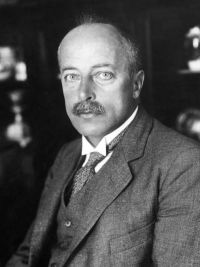
Portrait of Max von Laue Max von Laue On the Experiment of F. Harress

The optics of bodies moving without acceleration, is so uniform and interwoven in itself, that one can confirm or disprove it only as a whole. Any confirmation of any of its statements, is a benefit of the whole.
Thus far, the presupposition of the theory is, that the accelerations connected with the rotation in no way influence the speed of light. General relativity supports this statement. Whether it is correct, can only be shown by a desirable repetition of the experiment.
Source: Wikisource

Portrait of Max von Laue Max von Laue On the Experiment of F. Harress

First – although this is without practical importance in the light of the present precision of Harress's experiment, but it is of principal importance –, Harzer overlooks that also the parts of the light path traversed in the rotational apparatus, which are lying in the air, are contributing to the phase difference at the interference. Then Harzer with full justification considers that the light ray must be curved in the rotating body. Yet the approach, from which he finds out its shape, [6] is not self-evident in our view, although it can surely be demonstrated from relativity theory.
Source: Wikisource

Portrait of Max von Laue Max von Laue On the Experiment of F. Harress

General relativity would of course be capable of giving some statements about it, and we want to show at first that no noticeable influences of acceleration are expected according to it. The occurring centrifugal forces are namely of a magnitude of at most 10 to 100 times as great as Earth's attraction upon the same body. Now, since gravitational acceleration itself has no noticeable influence upon the optical processes even in respect to much mightier celestial bodies than Earth, then such one isn't expected in Harress's experiment as well.
Source: Wikisource

Get perspective with Kwize: daily news enlightened by great literature